Ask ChatGPT, Gemini or Google’s AI Mode for “the best running shoes for flat feet” or “a reliable plumber near me”, and the answer often reads like a summary of customer reviews: what people like, what they complain about, and who the product suits.
That has made reviews one of the most discussed topics in AI search optimization. Agencies and software vendors now publish guides claiming reviews are a key ranking signal for AI answers. Some of that is well founded. Some of it is a sales pitch.
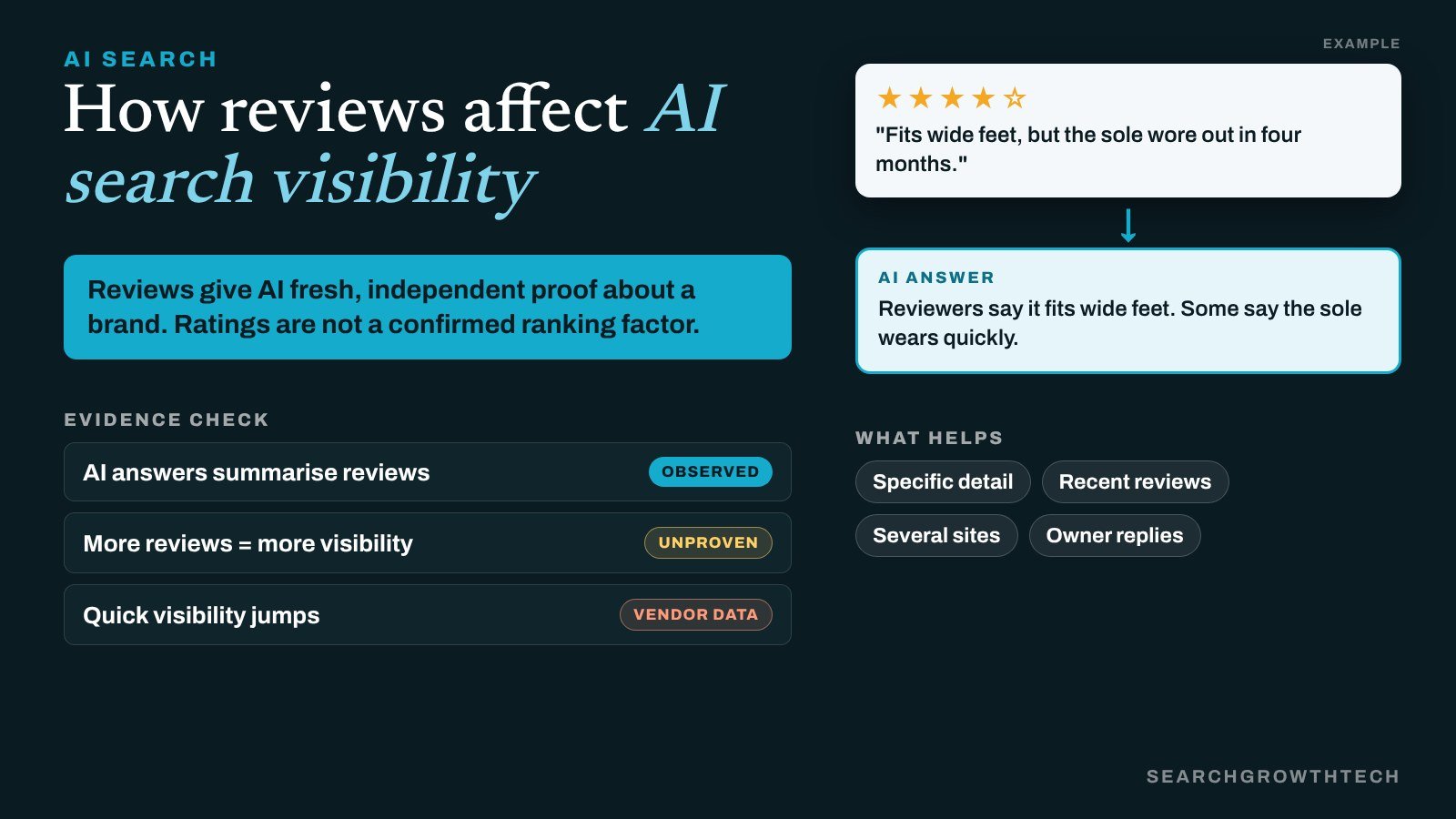
In short: reviews help AI search visibility because they give AI systems fresh, specific, third-party evidence about what a product or business is like. But no AI platform has published review volume or star rating as a ranking factor, and the public evidence so far comes mostly from vendors who sell review tools.
Here is what we know, what is still unproven, and what to do about it.
Why AI Search Pays Attention to Reviews
When someone asks an AI assistant for a recommendation, the system has to answer two questions: which options fit, and how good are they? Your own website can answer the first. It cannot credibly answer the second.
Reviews fill that gap in four ways:
- They are independent. Customers, not marketing teams, write them, so they carry more weight as evidence.
- They are specific. Reviews describe real use: sizing, setup, support response times, what broke and when.
- They are fresh. New reviews keep arriving long after a product page stops being updated.
- They match how people ask. Shoppers ask AI tools conversational questions, and reviews are written in the same plain language.
Google has also made reviews more visible inside its own AI features. In March 2026 it launched Ask Maps, a conversational experience in Google Maps that, according to Google, draws on more than 300 million places and reviews from more than 500 million contributors.
Three Types of “Reviews” That Get Mixed Up
Many guides treat every review as the same thing. They are not, and they reach AI answers in different ways.
| Type | Examples | How it can reach AI answers |
|---|---|---|
| Third-party customer reviews | Google Business Profile, Trustpilot, G2, Capterra, Amazon, Yelp | Public pages that AI systems can find and cite as independent evidence |
| On-site customer reviews | Reviews on your own product or service pages | Useful detail on pages you control, but less independent |
| Editorial review articles | “Best CRM for small teams” roundups, expert product tests | Often the pages AI answers summarise for “best” questions |
Google’s reviews system, for example, is about review articles: content that evaluates products. It is not a system for ranking businesses by their star ratings. Mixing the two leads to the wrong strategy.
What We Know vs. What Is Still Unproven
We reviewed the most visible guides on this topic, from agencies, review platforms and AI visibility tool vendors. Here is how their main claims hold up.
| Claim | Status |
|---|---|
| AI answers often summarise review sentiment and themes | Observable. You can see it in many shopping and local answers. |
| Reviews on public, crawlable pages can be cited by AI tools | Observable. Review platforms regularly appear as cited sources. |
| More reviews mean more AI visibility | Unproven. No AI platform has published this as a ranking factor. |
| Higher star ratings lead to more AI recommendations | Unproven. Ratings add context, but answers also weigh fit and trade-offs. |
| Review schema markup gets you cited in AI answers | Unproven. Markup helps systems understand a page; it does not guarantee citations. |
| Review campaigns raised brands’ AI visibility within weeks | Vendor data only. Results come from the vendor’s own clients, without published methods or control groups. |

The most detailed test we found came from Trustmary, a review software company. It said it monitored 76 companies and that about two thirds of the 37 it tracked for three weeks or longer increased their visibility in AI answers. The study is useful as a signal, but it does not disclose its prompts or scoring, and the companies were Trustmary’s own customers.
The Review Signals That Matter Most
Based on how AI answers are built and what we can observe in them, these are the qualities that make review content useful evidence:
- Specificity. “Fits wide feet, but the sole wore out in four months” is more useful to an AI answer than “Great product!”
- Recency. A steady flow of recent reviews shows the evidence still reflects the current product or service.
- Spread across platforms. Reviews on several respected sites look more trustworthy than a pile of reviews in one place.
- Consistency with your own pages. If reviews praise a feature your site never mentions, AI tools have nothing on your site to connect it to.
- Visible responses. Thoughtful replies, especially to negative reviews, add context and show the business is active.
Negative reviews are not automatically a problem. A product with a believable mix of praise and criticism often gives an AI answer more to work with than a wall of five-star ratings.
How to Improve Your Review Footprint for AI Search
- Find the questions that matter. List 10 to 20 prompts a customer might ask, such as “best [product] for [use case]” or “[service] near [city]”.
- See what AI tools say now. Run those prompts in ChatGPT, Gemini, Perplexity and Google AI Mode. Note which brands appear and which review sites are cited.
- Focus on the review platforms that get cited. If answers in your category cite G2 or Google Maps, that is where fresh, detailed reviews matter most.
- Ask for detail, not just stars. Prompt customers with questions about how they use the product and what problem it solved.
- Ask at the right moment. Request reviews soon after a successful delivery, project or support case, and make the link one tap away.
- Feed review themes back into your pages. If customers keep mentioning a use case, cover it on your product or service page and in your FAQs.
- Retest on a schedule. Re-run the same prompts monthly. AI answers change often, so look for trends, not one-off results.
Stay Within the Rules
Some guides recommend paying customers for reviews. Be careful. Google’s policies prohibit offering incentives for Google reviews, and the US Federal Trade Commission’s rule on fake reviews, in force since October 2024, bans fake reviews and incentives that depend on the review being positive. Platforms that allow incentives usually require them to be disclosed. Fake or filtered reviews can get removed, and they put far more than AI visibility at risk.
What This Means for SEO Teams
Reviews are now part of the evidence AI search uses to describe a brand. That makes review management an SEO and AI visibility task, not just a customer service one.
It also means owned content and reviews have to work together. Reviews can tell AI tools that people trust you; your pages still have to explain what you offer and who it is for. Our AI Search coverage tracks how Google’s AI features are changing, and our explainer on the main goal of generative AI covers why AI answers favour original, specific content.
Key Takeaways
- Reviews give AI search fresh, specific and independent evidence about products and businesses.
- No AI platform has confirmed review count or star rating as a ranking factor.
- Most published results on reviews and AI visibility come from vendors that sell review tools.
- Detail, recency, spread across platforms and alignment with your own pages matter more than volume alone.
- Avoid paid or filtered reviews: they break Google and FTC rules and can backfire.
FAQs
Do Reviews Affect AI Search Visibility?
Yes, indirectly. AI tools often use reviews as evidence when describing or recommending products and businesses. But no platform has published reviews as a direct ranking factor.
Do More Reviews Mean ChatGPT Will Recommend My Brand?
Not necessarily. Volume helps show a product is established, but detailed, recent reviews on sites that AI tools cite are likely to matter more than raw count.
Which Review Sites Matter Most for AI Search?
It depends on your category. Local businesses should focus on Google Business Profile, software companies on sites like G2 and Capterra, and retailers on marketplaces and review platforms. Check which sites AI answers cite in your niche.
Does Review Schema Help With AI Overviews?
Structured data helps search engines understand review information on your pages, but it does not guarantee your page will be cited in AI Overviews or AI Mode.
Are Negative Reviews Bad for AI Visibility?
Not by themselves. A realistic mix of reviews, with thoughtful responses to complaints, is more credible than only five-star ratings.
Can I Pay for Reviews to Improve AI Visibility?
It is risky. Google prohibits incentives for Google reviews, and the FTC bans fake reviews and incentives tied to positive sentiment. Focus on asking real customers at the right time.