Every week brings a new acronym and a new tactic for AI search. Google’s own people are giving simpler advice. On Google’s Search Off the Record podcast, a Search engineering director said there is no magic wand, and Google’s guide to generative AI search says optimizing for it is still SEO.
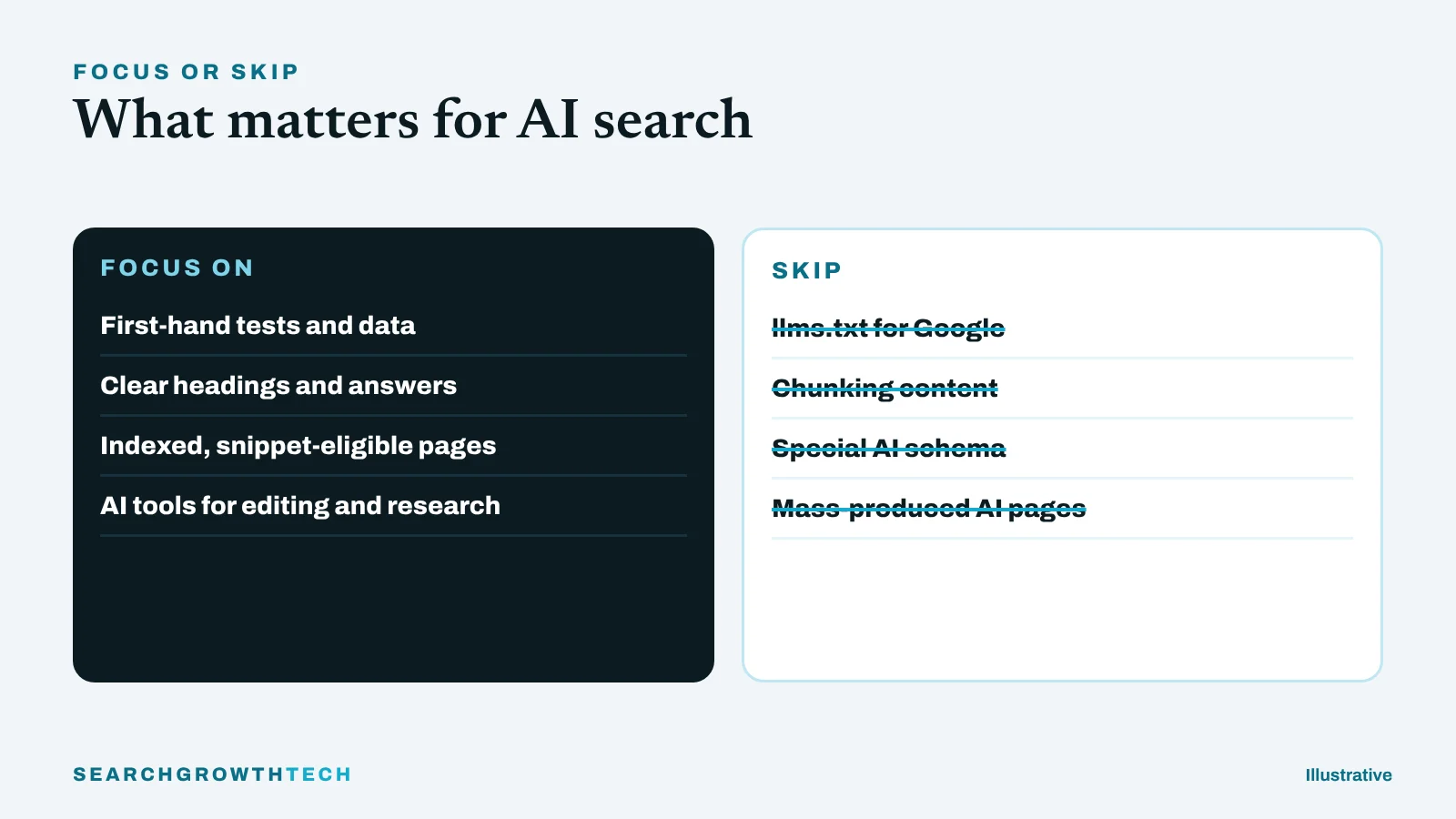
In short: Focus on content that gives real, first-hand value, keep your technical SEO strong so pages can be indexed and shown with a snippet, and use AI tools to work smarter rather than to mass-produce pages. Skip AI-specific tricks such as llms.txt files, content chunking or special markup, which Google says its Search doesn’t need. Measure results in Search Console.
What Google’s Engineers Said
On Search Off the Record episode 109, Nikola Todorovic, Director of Software Engineering at Google Search, said site owners need to keep making sure their products and websites provide value to users. If they do, he said, users will keep coming to them, including through Google.
He encouraged SEOs to master AI tools and use them well, for tasks such as improving grammar and style, understanding data or understanding competitors. He warned against simply generating lots of content because it is cheap and easy, since that won’t provide much value. Martin Splitt added a pointed example: articles that only put words around a manufacturer’s spec sheet add nothing a chatbot can’t already do. The value is in what you have tested yourself.
Seven Priorities for SEO in AI Search
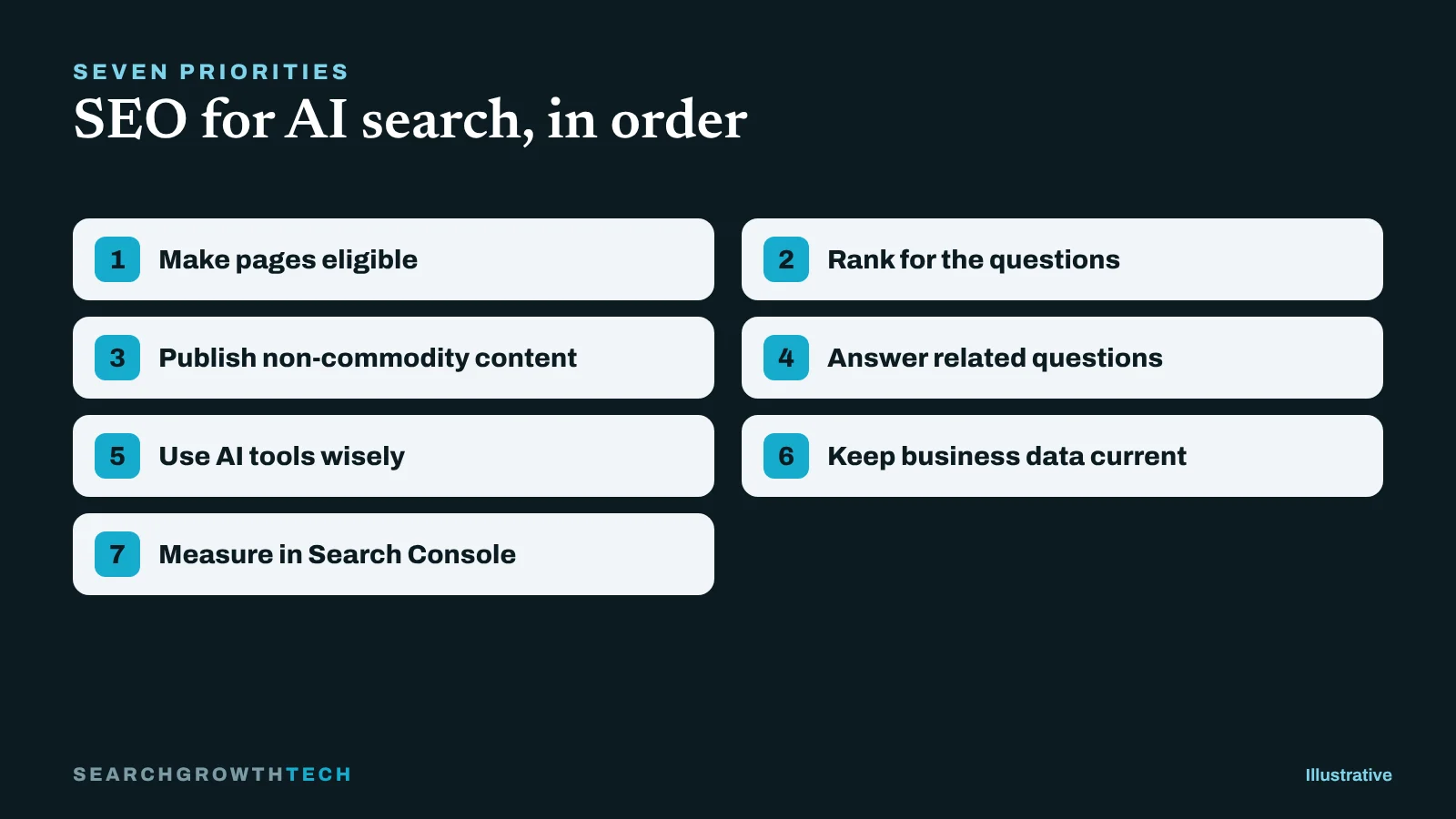
1. Make Pages Eligible First
Google says a page must be indexed and eligible to show with a snippet to appear in AI Overviews or AI Mode. Allow crawling, link pages internally and keep important content in text. See how Google Search works.
2. Rank, Because AI Answers Start With Ranking
Todorovic said AI Overviews sit on top of Google’s classic retrieval and ranking systems. Pages still need to be retrieved and ranked to be used. Read how AI Overviews work.
3. Publish Non-Commodity Content
Google’s generative AI optimization guide asks for a unique point of view built from your own knowledge and experience, and warns that generic listicles add little. Add tests, data, photos, prices and examples.
4. Answer the Questions Around a Topic
Google may split a long question into several related searches, called query fan-out. Cover the natural follow-up questions on one strong page with clear headings. See query fan-out explained.
5. Use AI Tools to Work Better, Not to Publish More
Both Google speakers use AI tools themselves. Use them for editing, analysis and research. Google says AI-generated content must still meet Search Essentials and spam policies, and pages made mainly to manipulate rankings or AI responses can violate its scaled content abuse policy.
6. Keep Business and Product Data Current
Google says Merchant Center feeds and Business Profiles help products and businesses appear in AI responses. Keep them accurate.
7. Measure in Search Console
Google counts AI feature traffic in the Performance report under Web search, and its guide points to the generative AI performance report. Be wary of tools that claim access to Google’s internal AI metrics. Google says no third-party tool has it.
What to Skip
| Tactic | What Google says |
|---|---|
| llms.txt files | Google Search ignores them. They won’t help or hurt visibility. |
| Chunking content into small pieces | Not needed. There’s no ideal page length. |
| Rewriting for AI phrasing or every long-tail variation | Not needed. AI understands synonyms and intent. |
| Special AI schema | None exists. Structured data still helps rich results. |
| Buying inauthentic brand mentions | Not effective, and Google’s systems are built to resist spam. |
How to Audit a Page for AI Search Value
- Eligibility: Is the page indexed in URL Inspection, and can it show a snippet?
- Ranking: Does it rank for its main query and the questions around it?
- Originality: Does it include anything a chatbot couldn’t produce from the spec sheet or the top results?
- Structure: Can a reader find each answer quickly under a clear heading?
- Trust: Is it clear who wrote it, what experience they have and when it was updated?
- Experience: Does the page load fast and keep the main content clearly separated from ads and extras?
- Measurement: Are its clicks and long queries tracked in Search Console?
Pages that fail the originality step are the ones most at risk, since an AI answer can summarize them without anyone needing to click.
Examples of Value AI Can’t Copy
| Page type | Commodity version | Value-added version |
|---|---|---|
| Product review | Restates the manufacturer’s specs | Shows your own test results, photos and who it suits |
| Local business | Generic service list | Real prices, availability, photos of past work and reviews |
| How-to guide | Steps copied from top results | Steps you tested, mistakes to avoid and screenshots |
| Industry news | Rewritten press release | Context, data checks and what it means for the reader |
This matches Splitt’s point on the podcast: if you have tested something and found it especially good or bad for a use case, that insight is yours, and AI doesn’t have it.
A 30-Day Plan
- Week 1: Check indexing and snippet eligibility for your top 20 pages in Search Console.
- Week 2: Pull long queries for those pages and list unanswered follow-up questions.
- Week 3: Add original detail and answer the missing questions on the five most important pages.
- Week 4: Review Search Console trends and choose the next five pages.
Repeat monthly. The work is ordinary SEO, which is the point Google keeps making: what helps people and earns rankings is also what AI answers draw on.
Key Takeaways
- Google says optimizing for AI search is still SEO.
- Value, first-hand insight and strong basics matter most.
- AI answers rely on pages Google already retrieves and ranks.
- Use AI tools for quality and efficiency, not mass publishing.
- Skip llms.txt, chunking and AI phrasing tricks for Google Search.
Next, read our guide on how to get featured in AI search.
FAQs
Is SEO still relevant for AI search?
Yes. Google’s guide says optimizing for generative AI search is optimizing for the search experience, and so still SEO.
Does Google penalize AI-generated content?
Google says AI-generated content must meet its Search Essentials and spam policies. Content made mainly to manipulate rankings can break the scaled content abuse policy.
Do I need an llms.txt file for Google?
No. Google says its Search ignores llms.txt files.
What is the most important thing for AI search visibility?
According to Google’s engineer, providing real value to users. Technical eligibility and original, helpful content come first.