Every week, another guide promises a secret formula for getting into Google’s AI Overviews or ChatGPT’s answers. Add this schema. Upload this file. Rewrite everything for “AI SEO”.
Google’s own documentation says something much simpler, and most of those guides ignore it.
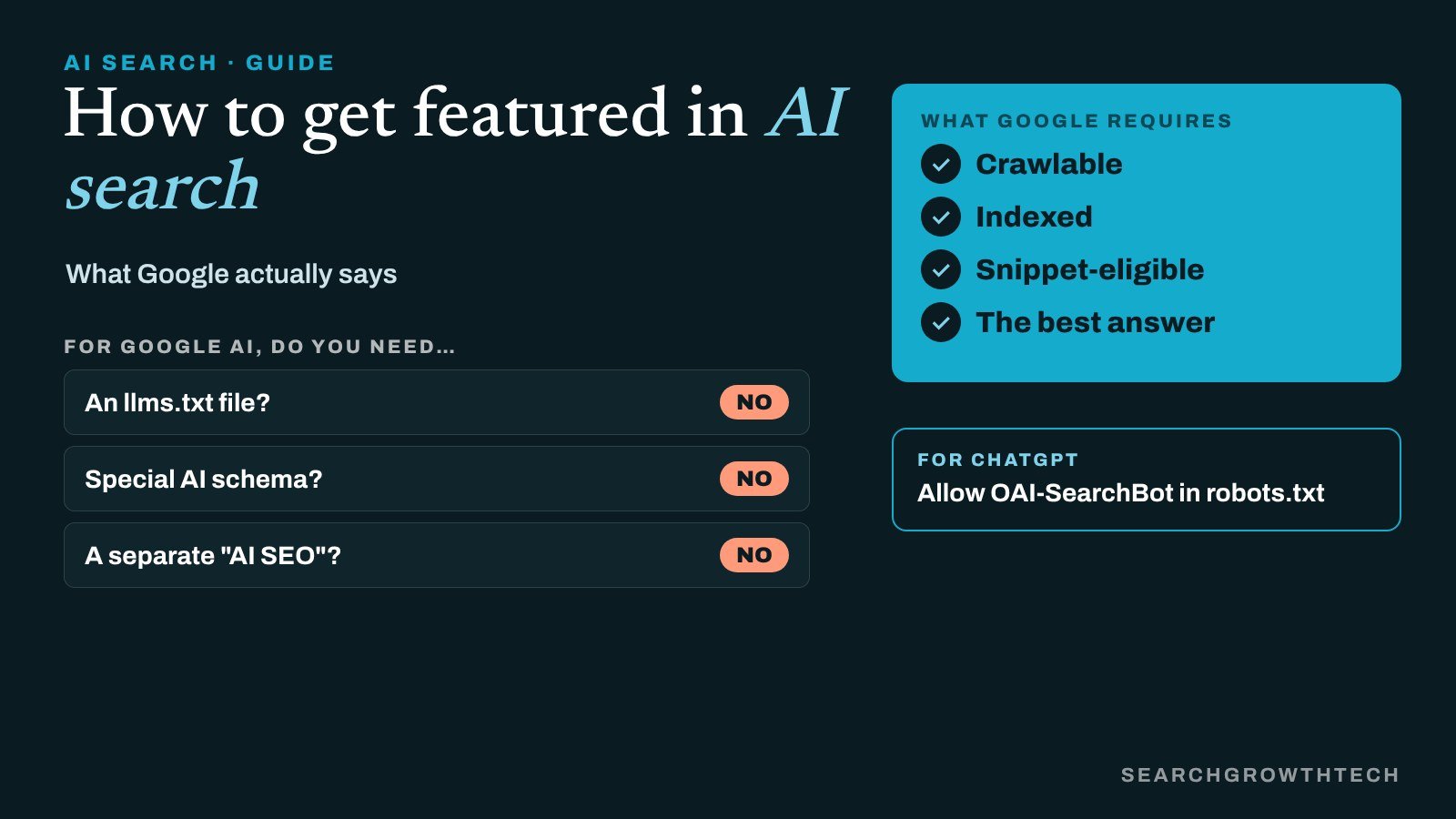
In short: to get featured in AI search, your pages need to be crawlable, indexed and eligible to show a snippet, and they need to be the most useful answer to the questions people ask. Google says there are no extra requirements and no special markup needed for AI Overviews or AI Mode. ChatGPT and Perplexity work differently, so they need a few extra checks.
Here is what Google actually says, which popular advice is a myth, and a practical checklist for each platform.
Watch: How to Get Featured in AI Search
What Google Says About AI Overviews and AI Mode
Google’s Search Central page on AI features and your website is the most authoritative source on this topic. Its key points:
- No special optimization. Google states there are “no additional requirements to appear in AI Overviews or AI Mode, nor other special optimizations necessary.”
- Normal eligibility. A page must be indexed and eligible to appear in Google Search with a snippet. There are no extra technical requirements.
- No new files or markup. You do not need AI text files, new machine-readable files or special schema to appear.
- No guarantees. Meeting the requirements does not guarantee a page will be crawled, indexed or shown.
- More pages get a chance. AI Overviews and AI Mode may use “query fan-out”, running several related searches to find supporting pages. Google says this lets it show a wider and more diverse set of links than classic results.
In other words, AI features are built on top of Google Search. If your page can rank and show a snippet, it can be linked from an AI answer.
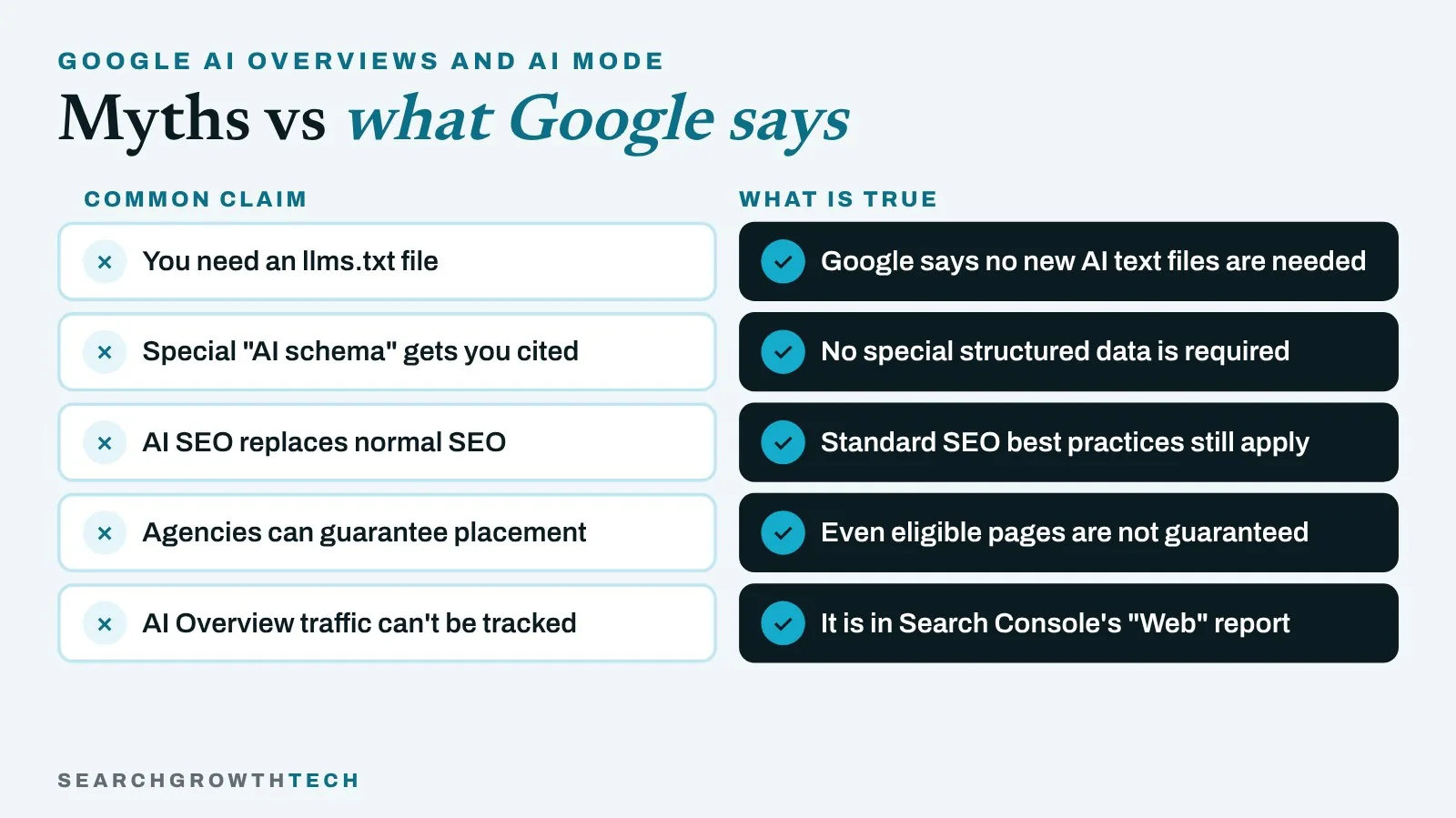
Myths vs. Facts
| Common claim | What is true |
|---|---|
| You need an llms.txt file | Google says no new AI text files are needed for AI Overviews or AI Mode. |
| Special “AI schema” gets you cited | Google says no special structured data is required. Schema should simply match what is visible on the page. |
| AI SEO replaces normal SEO | Google says standard SEO best practices still apply to AI features. |
| E-E-A-T is a ranking factor you can score | E-E-A-T comes from Google’s quality rater guidelines. It describes what helpful content looks like; it is not a single signal. |
| Agencies can guarantee AI Overview placement | No one can. Google says even eligible pages are not guaranteed to be shown. |
| AI Overview traffic cannot be tracked | It is included in Search Console’s Performance report under the “Web” search type. |
Technical Checklist: Make Sure You Are Eligible
Most pages that never appear in AI answers have a basic access or indexing problem. Check these first:
- Allow crawling. Make sure robots.txt does not block Googlebot, and check that your CDN, firewall or hosting security is not blocking it either.
- Get indexed. Use the URL Inspection tool in Search Console to confirm important pages are indexed.
- Check snippet controls. Settings like
nosnippet,data-nosnippetandmax-snippetlimit what Google can show. Use them only where you mean to. - Keep key content in text. Important information locked inside images, PDFs or scripts is harder for search systems to use.
- Link internally. Make important pages easy to find from related content.
- Match structured data to the page. If you use schema, it should describe what users can actually see.
- Update your Google listings. For local businesses and retailers, keep your Business Profile and Merchant Center details current.
A note on Google-Extended: blocking it controls whether your content is used to train and ground Google’s Gemini models. Google treats it separately from Search, so it is not the switch for AI Overviews. To limit what appears in Search, use the snippet controls above.
Content Checklist: Be the Best Answer
Once your pages are eligible, the question is whether they are the most useful source for the question. These practices help:
- Answer directly. Put a clear one or two sentence answer near the top, then explain.
- Cover the follow-up questions. Because AI search runs related searches behind the scenes, pages that answer the next logical questions have more chances to be linked.
- Add something new. Original data, first-hand testing, real examples and expert opinion are hard for an AI answer to replace.
- Use clear structure. Descriptive headings, short paragraphs, lists and tables make information easy to find and quote.
- Show who wrote it. Named authors with relevant experience and a visible updated date help readers trust the page.
- Support text with media. Google recommends high-quality images and video where they help.
- Keep it current. Update facts, prices and screenshots when things change.
None of this is new. It is the same advice that has always helped pages rank, which is exactly Google’s point.
How to Show Up in ChatGPT and Perplexity
ChatGPT search and Perplexity are not Google, so a few extra checks apply.
- Allow their search crawlers. OpenAI uses OAI-SearchBot to find pages for ChatGPT search, separate from GPTBot, which is used for training. Perplexity uses PerplexityBot. If your robots.txt or firewall blocks these crawlers, your pages are unlikely to be cited.
- Do not confuse training with search. You can block AI training bots and still allow search bots. Decide each one on purpose.
- Be mentioned elsewhere. AI assistants often cite third-party sources such as reviews, forums, directories and news coverage. Our analysis of AI search trends covers how these sources shape answers.
- Test your own prompts. Ask each assistant the questions your customers ask, and note which sources it cites.
How to Measure AI Search Visibility
- Search Console. Clicks and impressions from AI Overviews and AI Mode are included in the Performance report under the “Web” search type. They are not shown separately, so watch overall trends for the pages you optimize.
- Analytics. Track engagement and conversions. Google says clicks from results pages with AI Overviews tend to be higher quality, with visitors more likely to spend time on the site.
- Referral traffic. Visits from ChatGPT, Perplexity and other assistants usually appear as referrals in your analytics.
- A monthly prompt check. Keep a list of 10 to 20 important questions and record whether your brand or pages appear in each AI tool.
What This Means for SEO Teams
Getting featured in AI search is not a separate discipline with its own secret rules. It is good SEO, done thoroughly: accessible pages, clear answers, original value and a strong reputation beyond your own site.
The biggest risk is spending time on tactics that sound new but do nothing, while basic problems such as blocked crawlers or thin content go unfixed. Start with Google’s checklist, then build content that answers questions better than anyone else. For background on how these systems create answers, see our explainer on the main goal of generative AI.
Key Takeaways
- Google says there are no extra requirements or special optimizations for AI Overviews and AI Mode.
- Pages must be indexed and eligible to show a snippet; inclusion is never guaranteed.
- No llms.txt file or special schema is needed for Google’s AI features.
- ChatGPT and Perplexity need their own search crawlers to be allowed.
- Measure through Search Console’s “Web” report, analytics referrals and regular prompt checks.
FAQs
How Do I Get My Website Featured in Google AI Overviews?
Make sure your pages are crawlable, indexed and eligible to show a snippet, then create the most helpful answer to the question. Google says no special optimization is needed beyond standard SEO best practices.
Do I Need Schema Markup for AI Overviews?
No. Google says no special structured data is required. If you use schema, make sure it matches the visible content on the page.
Does llms.txt Help With AI Search?
Google says no new AI text files are needed for AI Overviews or AI Mode. It may not hurt, but it is not a requirement for Google’s AI features.
How Do I Get Cited in ChatGPT?
Allow OpenAI’s search crawler, OAI-SearchBot, make your content clear and useful, and build mentions on trusted third-party sites. Then test the questions your customers ask.
Can I See AI Overview Traffic in Search Console?
Yes, but not separately. It is included in the Performance report under the “Web” search type, together with other Google Search traffic.
Does Blocking Google-Extended Remove Me From AI Overviews?
No. Google-Extended controls the use of your content for Gemini training and grounding. To limit what appears in Google Search, including AI features, use snippet controls such as nosnippet or max-snippet.