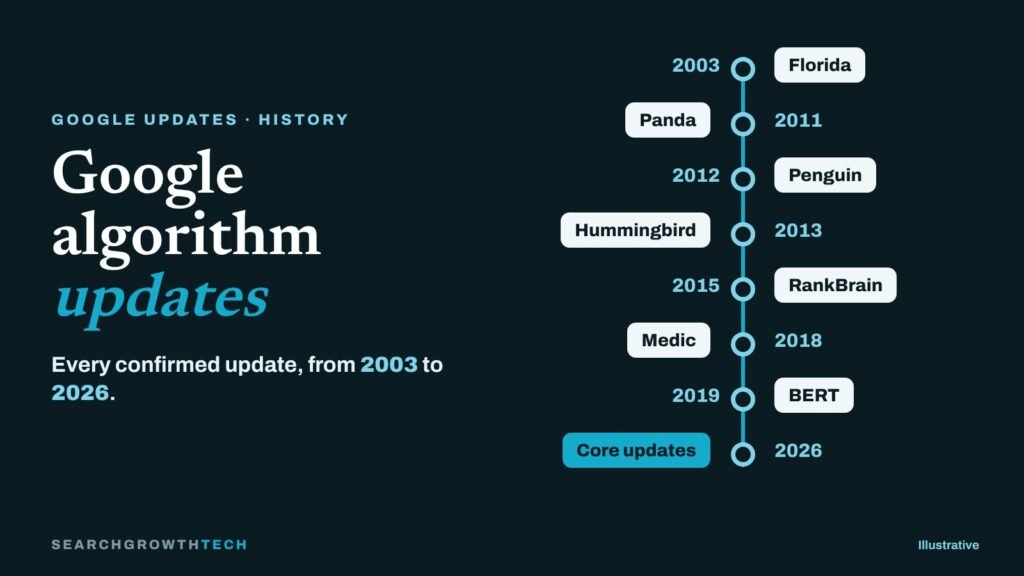
The Google Florida update was a major change to Google’s search rankings that hit in mid-November 2003. Overnight, many sites that had ranked well for commercial searches dropped out of the results, just weeks before the holiday shopping season.
Google never fully explained what Florida changed. SEOs at the time saw it as a crackdown on pages built to game rankings, such as keyword-stuffed pages and sites relying on manipulative links. Its real legacy is that it marked the end of easy ranking tricks and the start of the modern era of Google updates.
Here is what the Florida update was, why it mattered so much, who it hurt, and what its lessons mean for SEO today.
What Was The Google Florida Update?
Florida was an update to Google’s ranking algorithm in November 2003. It is widely seen as the first Google update to cause large, sudden ranking losses across a whole industry of websites.
The name did not come from Google. Brett Tabke, the owner of the WebmasterWorld forum and the PubCon conference, named it. He was naming Google updates the way hurricanes are named, and PubCon was holding a conference in Orlando, Florida, around that time. The name stuck across the SEO industry.
Before Florida, Google updated its index in a roughly monthly cycle that forum members nicknamed the “Google Dance.” Florida was different. It did not just reshuffle results. It changed which kinds of pages Google wanted to rank.
Google Florida Update: Key Facts
| Item | Details |
|---|---|
| Launch date | Mid-November 2003 (commonly dated November 16, 2003) |
| Announced by | Not formally announced by Google. Named by Brett Tabke of WebmasterWorld and PubCon |
| What it targeted | Never officially confirmed. Widely seen as targeting over-optimized pages and manipulative link patterns |
| Most affected | Commercial searches, including many affiliate and small retail sites |
| % of queries affected | Not stated by Google |
| Status today | Historic. Google’s ranking systems have been rebuilt many times since |
Why Did Google Launch Florida?
By 2003, ranking in Google had become fairly predictable. Many site owners had learned that repeating a keyword in titles, headings and body text, combined with plenty of links using that keyword as anchor text, could push a page to the top.
That made it easy to build thin pages that ranked well but did little for searchers. Commercial searches were especially crowded with pages built for rankings rather than people.
Craig Nevill-Manning, a senior research scientist at Google at the time, said publicly that there was no conspiracy behind the update. He described it as an effort to make Google’s results better, noting that some queries had been returning many irrelevant pages. He also acknowledged that any algorithm change will hurt some sites and help others.
What Did The Florida Update Target?
Because Google never published details, what follows reflects what SEOs observed and widely reported, not confirmed Google statements:
- Keyword stuffing: pages that repeated target phrases unnaturally in titles, headings, body copy and links.
- Manipulative link patterns: many observers believed Florida changed how Google evaluated links, so that unnatural linking patterns counted for less.
- Thin affiliate pages: pages that sent users on to merchants without adding much value of their own.
- Commercial queries: the biggest swings were reported on money-making searches rather than informational ones.
Many SEOs believed Florida targeted affiliate sites directly. Brett Tabke disputed that, saying some of his own non-affiliate sites were also hit hard.
Who Was Hit By Florida?
The losers were mostly sites that depended heavily on Google traffic for commercial searches. Affiliate marketers and small online retailers were among the most vocal, and some reported that pages that had ranked first for years disappeared from the results.
The timing made it worse. Florida landed just before the holiday shopping season, when many of these businesses expected their best sales of the year.
It was also messy. Many legitimate sites that were not spamming at all lost rankings. These “false positives” are a big part of why Florida is remembered as such a painful update, and why it started a long debate about how much a single search engine should control small business revenue.
Florida Versus “Florida 2”
In March 2019, Google confirmed a broad core update, and Brett Tabke nicknamed it “Florida 2” because it came shortly after another PubCon in Florida. The two updates share a name only. They used different algorithms and came from very different eras of Google search.
What The Florida Update Means For SEO Today
Florida is more than 20 years old, but the ideas behind it are now written into Google’s own rules. Here is how its lessons live on:
- Keyword stuffing is a named spam practice. Google’s spam policies list keyword stuffing as a violation that can lead to lower rankings or removal from results.
- Links have to look and be natural. Florida introduced many SEOs to the idea that unnatural linking patterns can backfire. That idea was taken much further by the Google Penguin update in 2012.
- Thin pages struggle. Pages that add little beyond what already exists were later targeted directly by the Google Panda update, and today by Google’s core ranking systems and its focus on helpful, people-first content.
- Diversify your traffic. Florida showed how quickly a business built on one traffic source can lose it. That lesson still applies after every core update.
To see how Florida fits into the bigger picture, read our complete list of Google algorithm updates.
Key Takeaways
- The Florida update hit Google’s rankings in mid-November 2003, shortly before the holiday shopping season.
- The name came from Brett Tabke of WebmasterWorld and PubCon, not from Google.
- Google never confirmed exactly what Florida targeted, but it was widely seen as a crackdown on keyword stuffing and manipulative links.
- Affiliate and small retail sites were among the hardest hit, along with many legitimate sites caught as false positives.
- Its core lesson, that tactics built to game rankings eventually stop working, still shapes Google’s spam policies today.
FAQs
When Did The Google Florida Update Happen?
It hit in mid-November 2003. It is commonly dated November 16, 2003, a couple of weeks before the busiest online shopping period of the year.
Why Is It Called The Florida Update?
Brett Tabke of WebmasterWorld named it, following a hurricane-style naming convention for Google updates. PubCon was holding a conference in Florida at the time. Google did not choose the name.
Did Google Confirm The Florida Update?
Google acknowledged that it had changed its results and said the goal was better search quality. It never published details of what the update targeted or how it worked.
Is “Florida 2” Related To The Original Florida Update?
No. “Florida 2” was an industry nickname for a broad core update Google confirmed in March 2019. Apart from the name, it has no connection to the 2003 update.