Google changes its search algorithm thousands of times a year. Most of those changes are small and go unnoticed. A handful each year are big enough that Google confirms them publicly, and those are the ones that can move rankings and traffic for millions of websites.
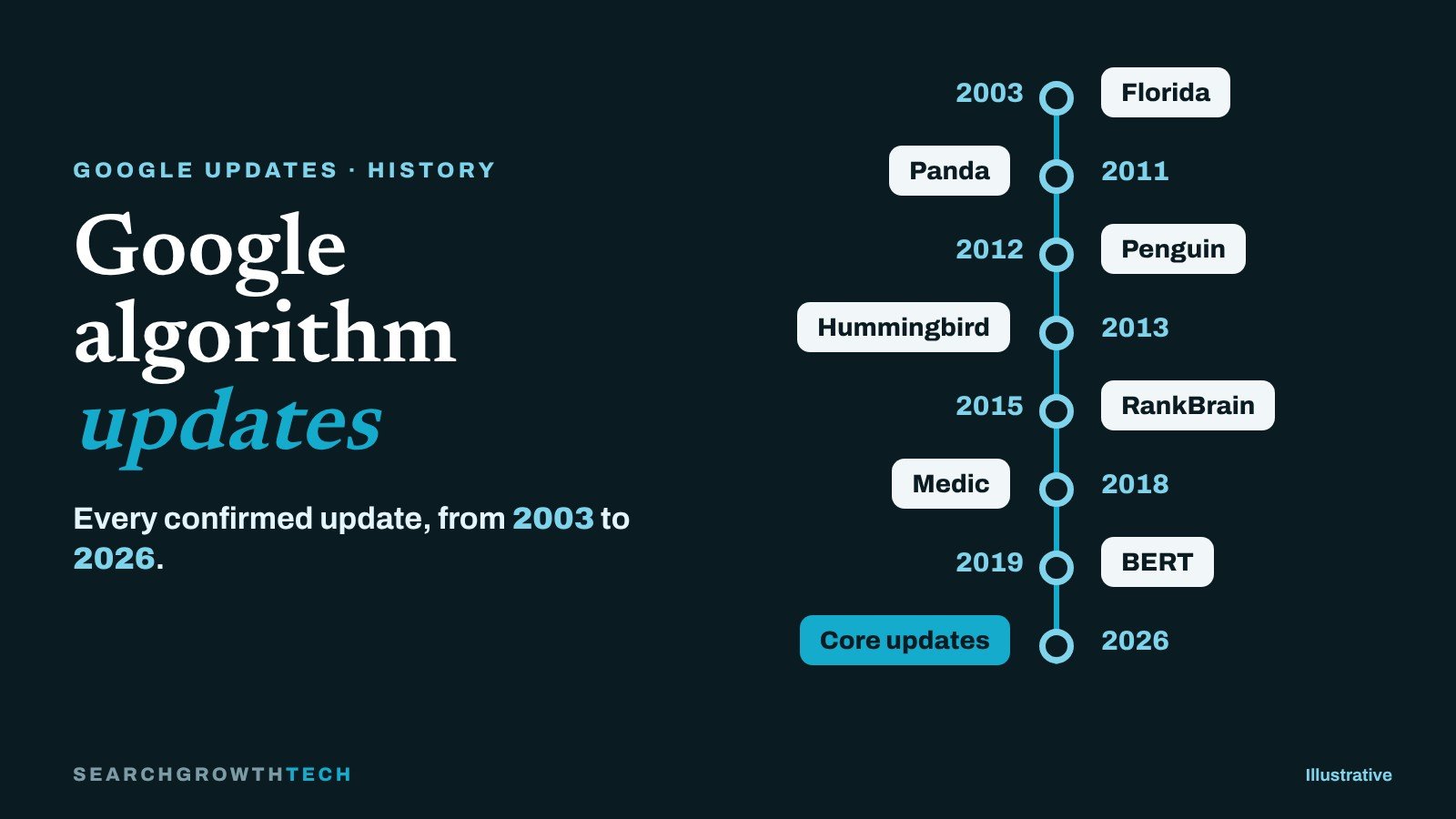
This guide lists every confirmed Google algorithm update from 2021 to today, taken from Google’s own Search Status Dashboard, plus the major named algorithms that shaped search before that, from Florida in 2003 to BERT in 2019.
We keep this page up to date as new updates are confirmed. You can also follow live rollouts on our Google updates tracker.
What Is A Google Algorithm Update?
Google uses a set of automated ranking systems to decide which pages to show for a search and in what order. An algorithm update is a change to one or more of those systems.
Google confirms the updates it considers notable. Since 2021, confirmed updates are posted on the Google Search Status Dashboard with a name, a start date and the time the rollout took to finish.
Confirmed updates usually fall into one of these types:
- Core updates: broad changes to Google’s overall ranking systems, released several times a year. They are not aimed at any one type of site or issue.
- Spam updates: improvements to SpamBrain and other systems that detect sites breaking Google’s spam policies.
- Helpful content updates: changes to the system that rewarded content made for people rather than for search engines. It became part of the core ranking systems in March 2024.
- Reviews updates: changes to how Google rewards in-depth, first-hand reviews. These started as product reviews updates in 2021.
- Discover updates: changes that affect which content appears in Google Discover rather than in search results.
Google Algorithm Updates In 2026
| Update | Started | Rollout time |
|---|---|---|
| September 2026 spam update | 24 September 2026 | 13 days, 16 hours |
| August 2026 spam update | 18 August 2026 | 2 days, 16 hours |
| June 2026 spam update | 24 June 2026 | 2 days, 1 hour |
| May 2026 core update | 21 May 2026 | 11 days, 21 hours |
| March 2026 core update | 27 March 2026 | 12 days, 4 hours |
| March 2026 spam update | 24 March 2026 | 19 hours, 30 minutes |
| February 2026 Discover update | 5 February 2026 | 21 days, 17 hours |
2026 has been a busy year for spam updates, with four confirmed so far. It also brought the first update Google has listed specifically for Discover, which matters for publishers who get a large share of traffic from the Discover feed.
Google Algorithm Updates In 2025
| Update | Started | Rollout time |
|---|---|---|
| December 2025 core update | 11 December 2025 | 18 days, 2 hours |
| August 2025 spam update | 26 August 2025 | 26 days, 15 hours |
| June 2025 core update | 30 June 2025 | 16 days, 18 hours |
| March 2025 core update | 13 March 2025 | 13 days, 21 hours |
2025 was a quieter year, with three core updates and one spam update. The August 2025 spam update was one of the longest spam rollouts on record, at almost four weeks.
Google Algorithm Updates In 2024
| Update | Started | Rollout time |
|---|---|---|
| December 2024 spam update | 19 December 2024 | 7 days, 2 hours |
| December 2024 core update | 12 December 2024 | 6 days, 4 hours |
| November 2024 core update | 11 November 2024 | 23 days, 13 hours |
| August 2024 core update | 15 August 2024 | 19 days, 4 hours |
| June 2024 spam update | 20 June 2024 | 7 days, 1 hour |
| March 2024 spam update | 5 March 2024 | 14 days, 21 hours |
| March 2024 core update | 5 March 2024 | 45 days |
The March 2024 core update was the biggest of the decade. It took 45 days to roll out, folded the helpful content system into Google’s core ranking systems, and arrived alongside new spam policies on scaled content abuse, site reputation abuse and expired domain abuse.
Google Algorithm Updates In 2023
| Update | Started | Rollout time |
|---|---|---|
| November 2023 reviews update | 8 November 2023 | 29 days |
| November 2023 core update | 2 November 2023 | 25 days, 21 hours |
| October 2023 core update | 5 October 2023 | 13 days, 23 hours |
| October 2023 spam update | 4 October 2023 | 15 days, 12 hours |
| September 2023 helpful content update | 14 September 2023 | 13 days, 11 hours |
| August 2023 core update | 22 August 2023 | 16 days, 3 hours |
| April 2023 reviews update | 12 April 2023 | 13 days, 2 hours |
| March 2023 core update | 15 March 2023 | 13 days, 7 hours |
| February 2023 product reviews update | 21 February 2023 | 14 days |
The September 2023 helpful content update hit many small publishers and affiliate sites hard. It was the last standalone helpful content update before the system became part of core ranking in 2024.
Google Algorithm Updates In 2022
| Update | Started | Rollout time |
|---|---|---|
| December 2022 link spam update | 14 December 2022 | 29 days |
| December 2022 helpful content update | 5 December 2022 | 38 days |
| October 2022 spam update | 19 October 2022 | 2 days |
| September 2022 product reviews update | 20 September 2022 | 6 days |
| September 2022 core update | 12 September 2022 | 14 days |
| August 2022 helpful content update | 25 August 2022 | 15 days |
| July 2022 product reviews update | 27 July 2022 | 6 days |
| May 2022 core update | 25 May 2022 | 15 days |
| March 2022 product reviews update | 23 March 2022 | 14 days |
| Page experience update for desktop | 22 February 2022 | 9 days |
August 2022 introduced the helpful content system, Google’s first sitewide signal aimed at content written mainly to rank rather than to help readers. The December 2022 link spam update used SpamBrain to neutralise unnatural links.
Google Algorithm Updates In 2021
| Update | Started | Rollout time |
|---|---|---|
| December 2021 product reviews update | 1 December 2021 | 20 days |
| November 2021 core update | 17 November 2021 | 13 days |
| November 2021 spam update | 3 November 2021 | 8 days, 1 hour |
| July 2021 link spam update | July 2021 | About 2 weeks |
| July 2021 core update | July 2021 | About 2 weeks |
| June 2021 spam updates (two parts) | June 2021 | 2 days |
| Page experience update (mobile) | June 2021 | Through August 2021 |
| June 2021 core update | June 2021 | About 10 days |
| April 2021 product reviews update | April 2021 | About 2 weeks |
The Search Status Dashboard launched in late 2021, so the earlier 2021 updates come from Google’s announcements at the time. The page experience update brought Core Web Vitals into ranking for the first time.
Major Google Algorithms Before 2021
Before Google started naming updates by month, the biggest changes had their own names. Several of them still shape how SEO works today.
| Year | Algorithm | What it did |
|---|---|---|
| 2003 | Florida | The first update to shake up the SEO industry. It targeted keyword stuffing and other manipulative tactics, just before the holiday shopping season. |
| 2010 | Caffeine | A new indexing system that let Google crawl and index the web much faster, giving fresher results. |
| 2011 | Panda | Demoted thin, low-quality and duplicate content, hitting content farms hardest. It became part of the core algorithm in 2016. |
| 2012 | Penguin | Targeted manipulative link building and over-optimised anchor text. It became real-time and part of the core algorithm in 2016. |
| 2013 | Hummingbird | A rewrite of the core algorithm to better understand the meaning of whole queries, not just individual keywords. |
| 2014 | Pigeon | Tied local search results more closely to traditional web ranking signals. |
| 2015 | Mobile-friendly update | Nicknamed “Mobilegeddon”. It boosted mobile-friendly pages in mobile search results. |
| 2015 | RankBrain | Google’s first machine learning ranking system, used to interpret searches it had not seen before. |
| 2018 | Mobile-first indexing | Google began using the mobile version of a page for indexing and ranking. The switch was completed for almost all sites in 2023. |
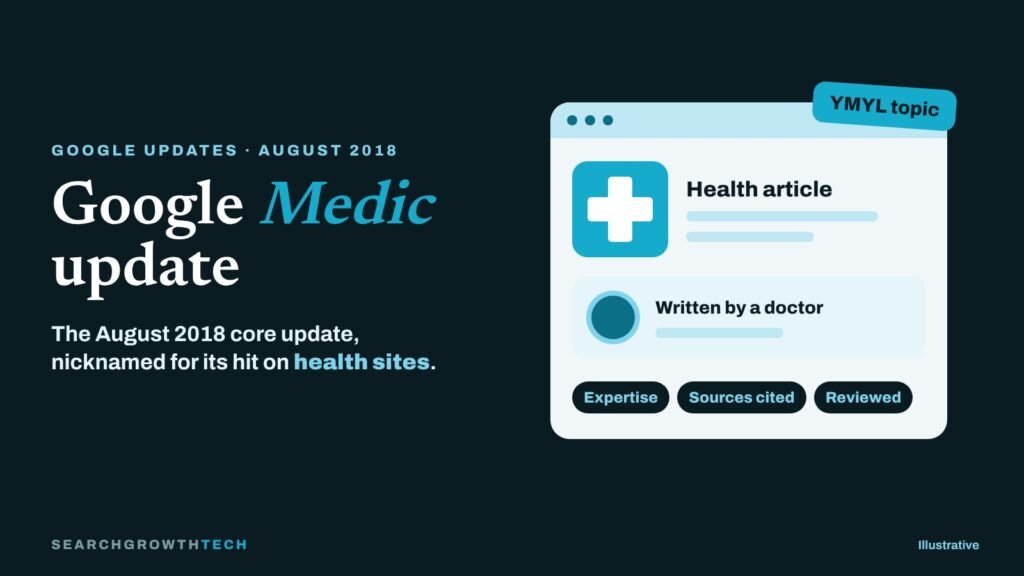
| 2018 | “Medic” core update | A broad core update in August 2018 that hit many health and finance sites, which drew attention to E-A-T (now E-E-A-T). |
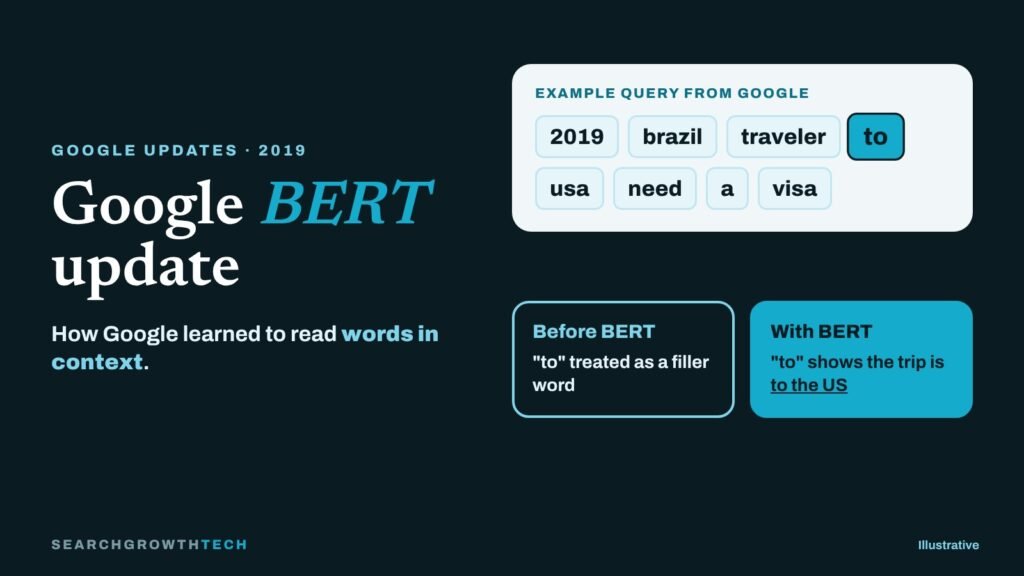
| 2019 | BERT | A language model that helps Google understand the context of words in a search, especially longer, conversational queries. |
Google’s Ranking Systems Today
Google publishes a guide to the ranking systems it uses now. Some of the best-known algorithms above are no longer separate systems, because their ideas were built into newer ones.
Systems Google says are in use today include:
- BERT, MUM and neural matching, which help Google understand language and concepts
- RankBrain, which links words in a search to real-world concepts
- PageRank and other link analysis systems
- Reviews system, which rewards insightful, first-hand reviews
- SpamBrain and other spam detection systems
- Freshness, deduplication, original content, passage ranking and site diversity systems
- Exact match domain, local news and removal-based demotion systems
- Reliable information and crisis information systems
Systems Google has retired or merged into others include Hummingbird, Panda, Penguin, the page experience system, the mobile-friendly ranking system, the page speed system, the secure sites (HTTPS) system and the helpful content system. Google says its core ranking systems still reward a good page experience, including Core Web Vitals, even though page experience is no longer a separate system.
How To Tell If An Update Affected Your Site
1. Check The Dates
Compare drops or gains in your traffic with the start and end dates of confirmed updates. Look at Search Console performance data, not only analytics, so you can see impressions and positions as well as clicks.
2. Wait For The Rollout To Finish
Rankings often move up and down during a rollout. Google advises waiting until an update has finished, then waiting at least another week before comparing results.
3. Compare Like With Like
Compare the same days of the week before and after the update, and rule out seasonality, tracking problems and site changes you made yourself.
4. Find The Pages That Changed
Drops are rarely sitewide. Identify which pages and queries lost visibility, then look at what now ranks above you for those queries.
5. Improve The Content, Not The Signals
Google says there is no specific fix for a core update. The pages that recover are usually those that become more helpful, more original and more trustworthy than the pages competing with them. For spam updates, the fix is to remove the practice that breaks the policy.
Key Takeaways
- Google confirms only its notable updates, and since late 2021 it lists them on the Search Status Dashboard.
- Core updates now arrive about three or four times a year and usually take two to three weeks to roll out.
- Spam updates have become more frequent, with four confirmed in 2026 so far.
- Famous algorithms such as Panda, Penguin and the helpful content system live on inside Google’s core ranking systems.
- If an update hits your site, wait for the rollout to finish, find the pages that changed and improve them for readers.
FAQs
How often does Google update its algorithm?
Google makes thousands of changes each year. It confirms only the notable ones, which has typically meant between four and ten updates a year since 2021.
What was the last Google algorithm update?
The most recent confirmed update is the September 2026 spam update, which started on 24 September 2026 and took 13 days and 16 hours to roll out. The most recent core update is the May 2026 core update.
What is the difference between a core update and a spam update?
A core update is a broad change to how Google assesses content overall. A spam update improves Google’s ability to detect sites that break its spam policies. Core update drops have no specific fix, while spam update drops are fixed by removing the spammy practice.
Can I recover from a Google algorithm update?
Yes. Recovery from a core update usually takes until the next core update, after you have improved your content. Google says some changes may show sooner, but bigger shifts generally come with later updates.
Where can I check whether an update is rolling out now?
Google posts confirmed updates on its Search Status Dashboard. Our Google updates tracker lists each one with its start date, rollout time and a link to Google’s announcement.