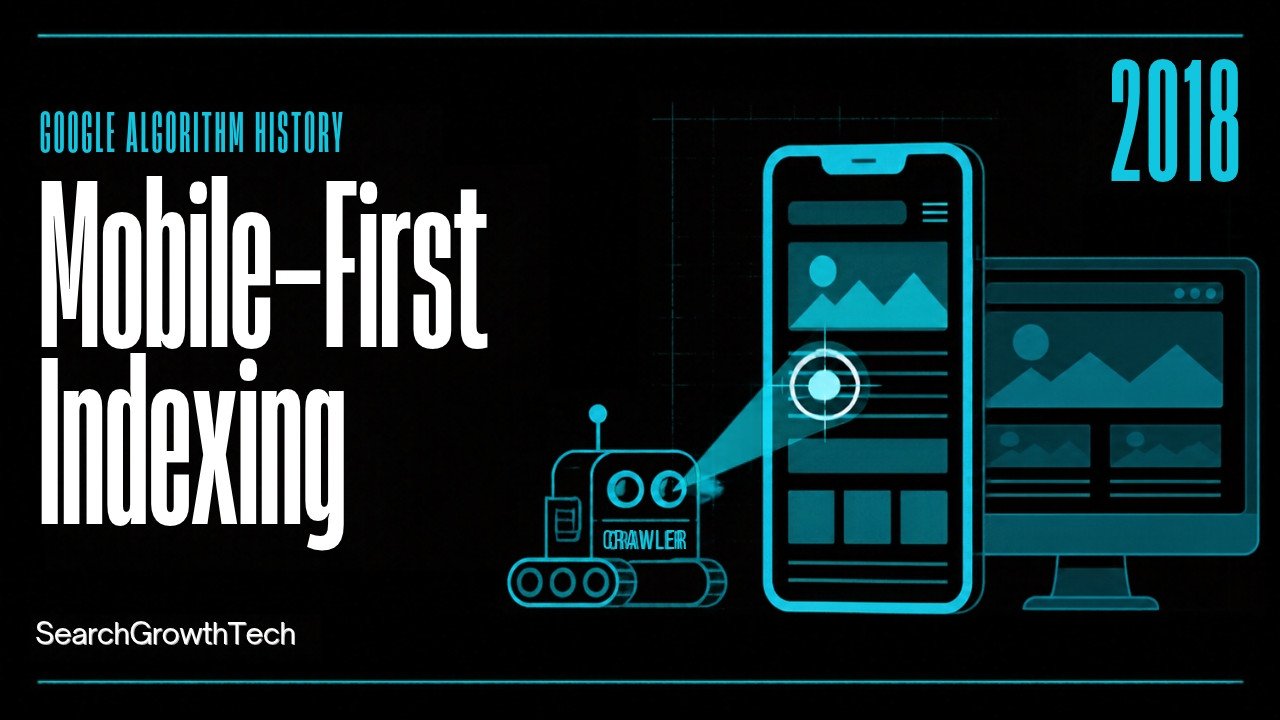
Mobile-first indexing is the change that made Google use the mobile version of a web page, rather than the desktop version, for indexing and ranking. Before it, Google’s crawler looked at pages mostly as a desktop computer would see them.
Google first announced experiments in November 2016 and began rolling the change out more widely in March 2018. It took several more years and a few missed deadlines, but in October 2023 Google said the switch was complete for almost all sites.
The idea is simple: Google should judge a site by what phone users actually see. Content missing from your mobile pages may not be seen at all.
What Is Mobile-First Indexing?
Mobile-first indexing means Google mainly crawls the web with its smartphone crawler, Googlebot Smartphone, and uses the mobile version of each page to decide what goes into its index and how it ranks.
It is not a separate mobile index. Google kept one index for everyone. What changed is which version of a page Google treats as the primary source. Desktop searchers still see results from the same index, built from mobile content.
It is also not the same as the 2015 mobile-friendly ranking update, often called Mobilegeddon. That update was a ranking boost for mobile-friendly pages in mobile results. Mobile-first indexing changed how Google collects and stores page content in the first place.
Mobile-First Indexing: Key Facts
| Item | Details |
|---|---|
| First announced | November 4, 2016, as an experiment |
| Wider rollout began | March 26, 2018 |
| Announced by | Google, on its webmaster (now Search Central) blog |
| What it did | Made the mobile version of a page the primary version for indexing and ranking |
| Crawler used | Googlebot Smartphone |
| Declared complete | October 31, 2023, for almost all sites |
| Status today | The standard way Google indexes the web |
Why Google Launched Mobile-First Indexing
By the mid-2010s, more searches happened on mobile devices than on desktop. Yet Google’s index was still built mainly from desktop pages.
That caused a mismatch. Many sites served a cut-down mobile version with less text, fewer images or missing structured data. A page could rank on the strength of desktop content that a phone user would never see.
Google’s stated goal in 2018 was to help its mostly mobile users find what they are looking for. Indexing the mobile version brought the index in line with the experience most searchers actually had.
How Mobile-First Indexing Works
For sites moved to mobile-first indexing, Google changed several things:
- Crawling: most crawling is done by Googlebot Smartphone instead of the desktop crawler.
- Indexing: the content, links, structured data and metadata Google stores come from the mobile page.
- Ranking: the mobile version is used to rank the page in both mobile and desktop results.
- Notification: during the rollout, Google told site owners in Search Console when their site had been moved.
Google said in 2018 that mobile-first indexing on its own was not a ranking change. Sites were moved in batches, starting with those that already followed its mobile best practices. Sites without a mobile version stayed in the index during the transition.
Responsive sites, which serve the same HTML to every device, were the least affected. Sites with separate mobile URLs or thinner mobile content were most at risk.
Timeline Of The Mobile-First Rollout
| Date | What happened |
|---|---|
| November 2016 | Google announces it is experimenting with mobile-first indexing. |
| December 2017 | Google says it has moved a small number of sites over. |
| March 2018 | Broader rollout begins, with Search Console notifications for moved sites. |
| July 1, 2019 | Mobile-first indexing becomes the default for new websites previously unknown to Google. |
| March 2020 | Google sets a September 2020 target for the whole web and says about 70% of sites shown in its results have already switched. |
| July 2020 | The deadline is pushed back to March 2021. |
| November 2021 | Google drops the fixed deadline and leaves the final steps open-ended. |
| October 31, 2023 | Google says the move to mobile-first indexing is complete for almost all sites. |
| July 5, 2024 | Google says it will crawl the remaining sites only with Googlebot Smartphone. Content that cannot be accessed on mobile is no longer indexed. |
The delays gave site owners more time. Google linked the 2020 delay to the uncertainty of the COVID-19 pandemic, and in 2021 it said the remaining sites faced unexpected challenges that made a fixed date impractical.
Who Was Affected?
Most sites saw little change. Google moved sites in batches and only once their mobile pages looked ready, so there was no single day of sharp ranking movement as there is with a core update.
The sites that ran into trouble were usually those where the mobile version differed from desktop. Common problems reported during the rollout included:
- Text, images or videos shown on desktop but hidden or removed on mobile
- Structured data present on desktop pages but missing from mobile pages
- Different or missing title tags, meta descriptions and robots meta tags on mobile
- Mobile pages blocking resources that Googlebot Smartphone needed to render the page
- Lower-quality images or missing alt text on mobile
Sites with no working mobile experience at all were the last group to move. After July 2024, pages whose content does not load on a phone are no longer indexed.
What Mobile-First Indexing Means For SEO Today
Mobile-first indexing is no longer a project to prepare for. It is simply how Google sees your site. That makes the mobile version of every page your real page for SEO purposes.
In practice:
- Keep content parity. Make sure your main content, headings, internal links and images are the same on mobile and desktop.
- Match your markup. Structured data, titles, meta descriptions and canonical tags should be present on the mobile version.
- Test with a phone view. Check pages with the URL Inspection tool in Search Console, which shows what Googlebot Smartphone sees.
- Do not block resources. Allow CSS, JavaScript and images needed to render the mobile page.
- Prefer responsive design. Serving the same HTML to all devices removes most parity problems by design.
Content tucked into tabs or accordions on mobile is fine, as long as it is in the HTML Google crawls. What hurts is content that is removed entirely from the mobile page.
Mobile-first indexing is one of several big shifts in how Google reads the web. You can see where it fits in our complete list of Google algorithm updates, alongside earlier infrastructure changes like Caffeine.
Key Takeaways
- Mobile-first indexing made the mobile version of a page the primary version Google indexes and ranks.
- Google announced experiments in 2016, began a wide rollout in March 2018 and declared it complete for almost all sites in October 2023.
- There is still one Google index. Desktop results are built from mobile content.
- Since July 2024, content that cannot be accessed on mobile is not indexed.
- Keep content, links, markup and metadata identical across mobile and desktop.
FAQs
Is Mobile-First Indexing A Ranking Factor?
Not directly. Google said mobile-first indexing changes which version of a page is indexed, not how pages are scored. But if your mobile page has less content, Google ranks it on that smaller page.
Does Google Still Use A Desktop Crawler?
For general web indexing, Google now uses Googlebot Smartphone. Google has said the desktop crawler is still used for some specific purposes, so you may still see it in server logs.
Is Mobile-First Indexing The Same As Mobilegeddon?
No. Mobilegeddon was the industry nickname for Google’s 2015 mobile-friendly ranking update. Mobile-first indexing, from 2018, changed which version of a page Google uses to build its index.
Do I Need A Separate Mobile Site?
No. A responsive site that serves the same content to every device is the simplest way to meet mobile-first requirements.