Google changes its Search results thousands of times a year, and none of those changes ship on a hunch. On a recent episode of Google’s own podcast, a Search engineering director walked through how a change goes from an idea to a launch. Combined with the numbers Google publishes, it is one of the clearest pictures yet of how Search is built.
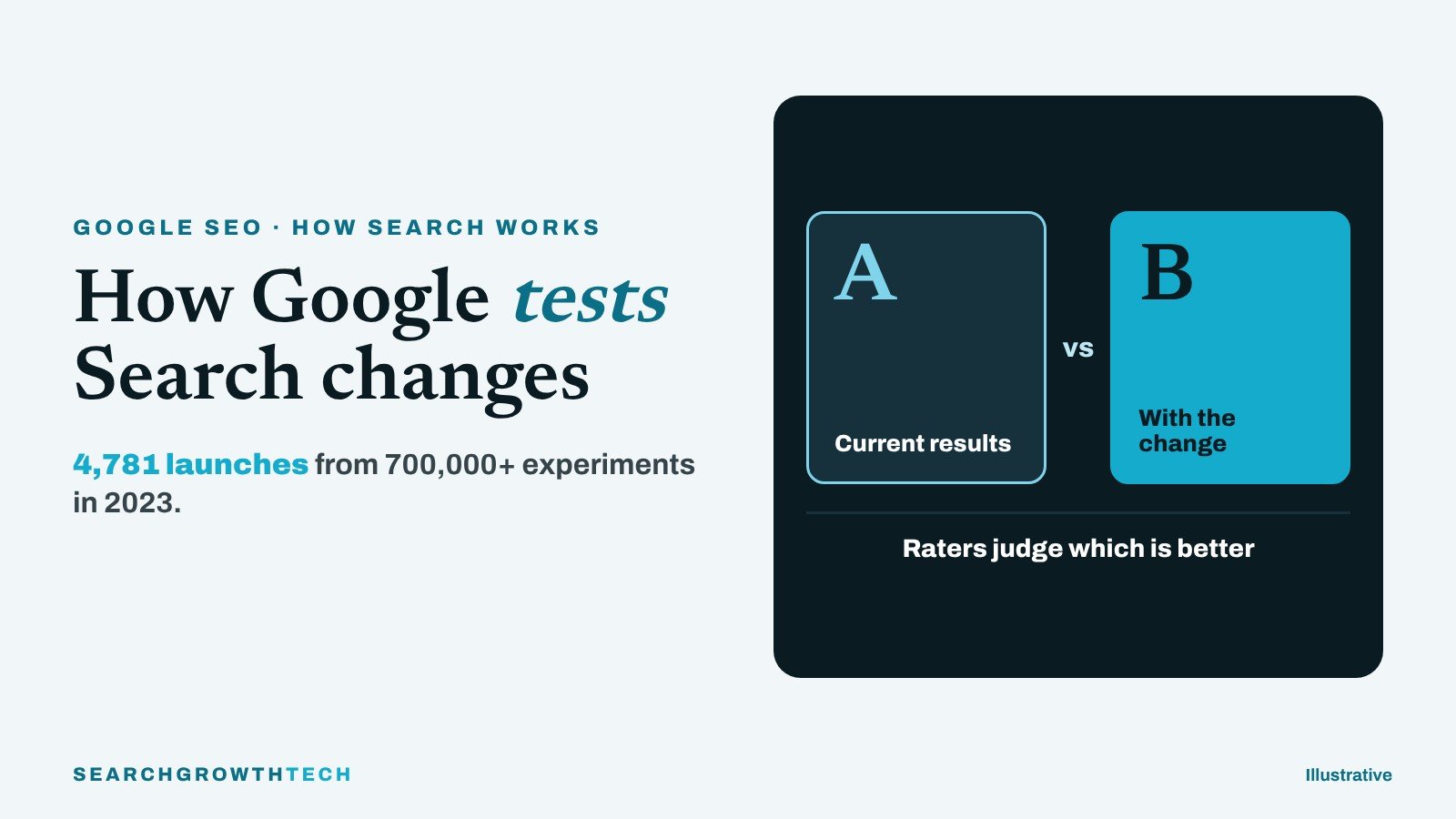
In short: A Google engineer builds an experimental version of Search and compares it with the live version. Human raters judge side-by-side results using Google’s published guidelines, and some changes are tested on a small share of real users. Promising changes then go to a launch review, where decision makers can send them back if they cause bad losses. In 2023, Google says it ran over 700,000 experiments and made 4,781 launches.
Where Search Changes Come From
On Search Off the Record episode 109, Google Search engineering director Nikola Todorovic said changes usually start from one of two places: a new technology that could improve results, or a known problem, such as a query that returns a result it shouldn’t. He said Google makes thousands of changes a year, and tracks and evaluates every one.
The Five Stages of a Search Change
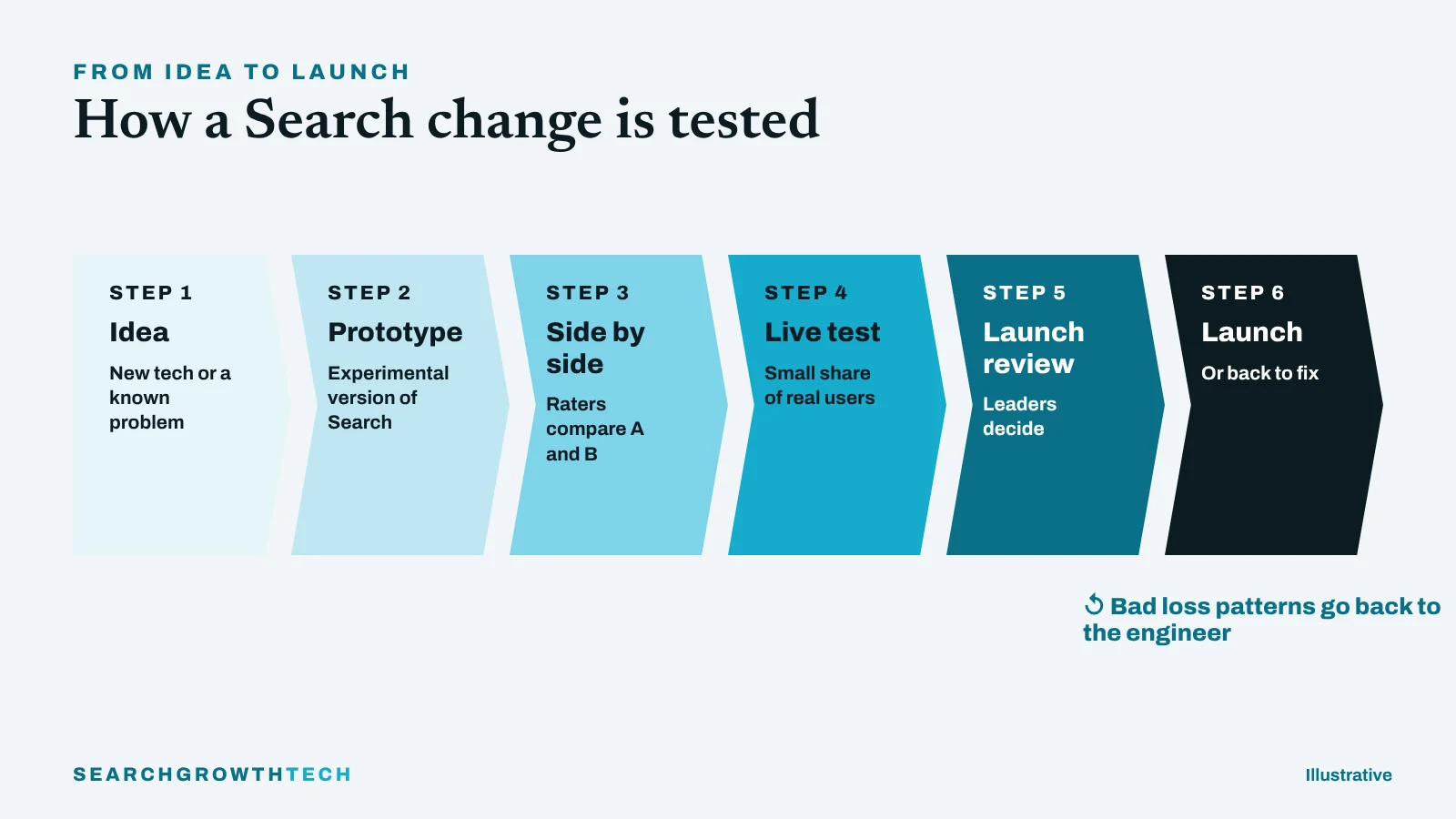
- Prototype. Engineers build an experimental version of Search with the change, alongside the production version.
- Side-by-side test. Raters see results from the experiment and from production for queries where the two differ, and judge which is better. Todorovic said they use Google’s published rater guidelines.
- Statistics. Those human reviews become statistics that show whether the experiment beats the baseline.
- Live traffic experiment. Google says it often turns a change on for a small share of users, usually starting at 0.1%, and compares behavior such as clicks and abandoned searches with a control group.
- Launch review. Engineers present results to leaders who make the final call. Todorovic said a change can improve overall numbers but still show a bad pattern of losses. In that case, the engineer is sent back to fix it.
Todorovic confirmed that AI features such as AI Overviews go through the same process.
Google’s Testing Numbers
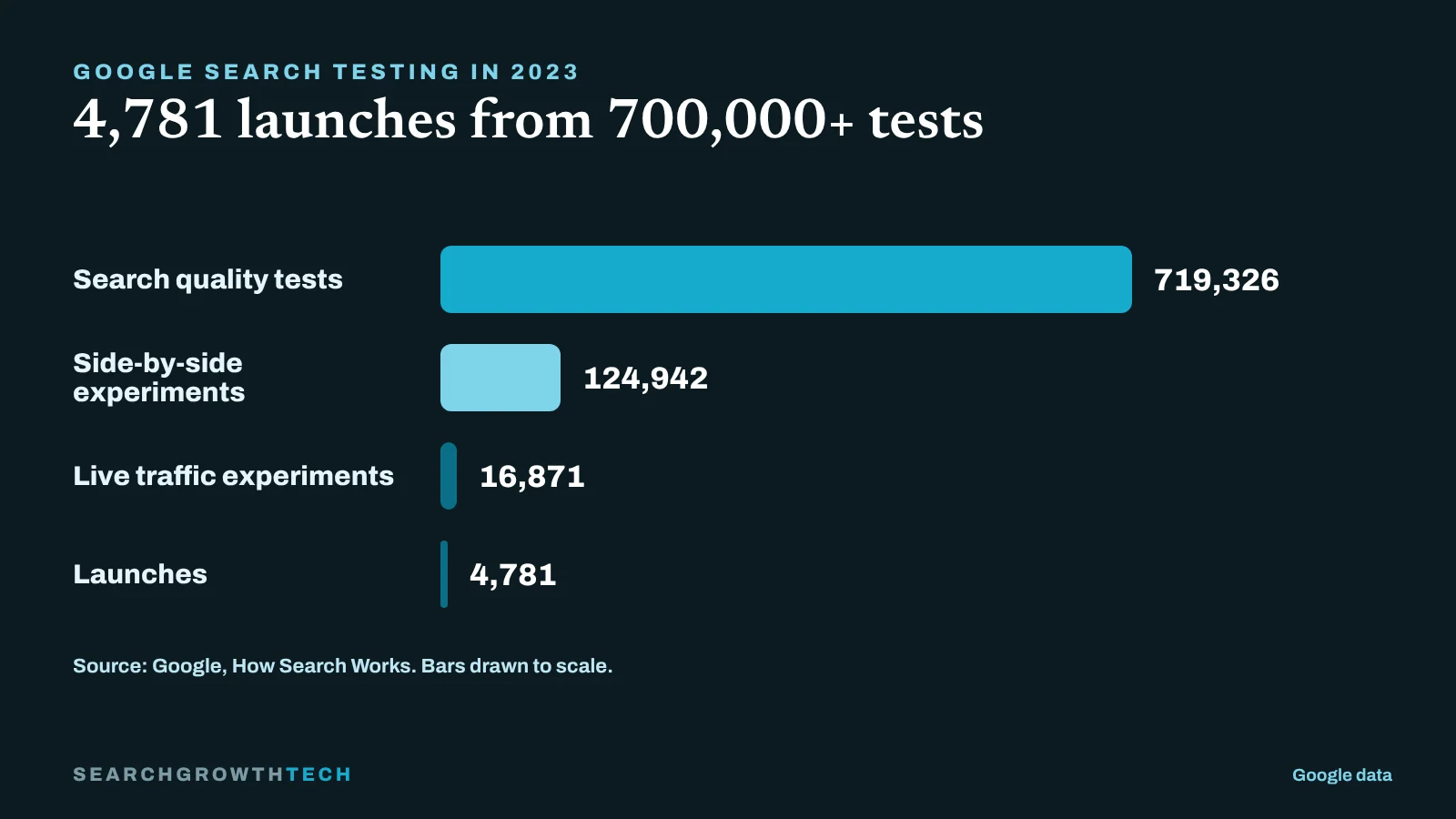
Google’s How Search Works page on rigorous testing lists these figures for 2023:
| Test type | 2023 total |
|---|---|
| Search quality tests | 719,326 |
| Side-by-side experiments | 124,942 |
| Live traffic experiments | 16,871 |
| Launches | 4,781 |
For comparison, Google reported for 2019 383,605 search quality tests, 62,937 side-by-side experiments, more than 17,000 live traffic experiments and more than 3,600 improvements. Side-by-side testing roughly doubled in four years.
Do Raters Decide Rankings?
No. Google says rater scores don’t directly affect how any page ranks. They are used in aggregate to measure whether a change makes results better. Google’s 2020 post said it had more than 10,000 raters worldwide. The guidelines they use are public, and the September 2025 update added examples for rating AI Overviews.
What This Means for SEO
- Read the rater guidelines. They show what Google is trying to reward, even though raters don’t rank pages.
- Expect constant change. With thousands of launches a year, small ranking movements are normal. Major ones, such as the November 2026 core update, are announced.
- AI features are tested too. They pass the same launch process as other changes.
What Raters Look At
Google’s rater guidelines ask raters to judge whether results meet the searcher’s likely need and how trustworthy the sources are. Google says raters evaluate content based on expertise, authoritativeness and trustworthiness, and research the reputation of sources. Their ratings are combined across many queries to measure whether a change makes results better overall.
Todorovic said the published guidelines are what help raters review the differences between the baseline and the experiment. That makes them a useful window into what Google is aiming for, even though no single rating moves a page.
What Live Experiments Measure
In a live traffic experiment, a small, random share of users sees the change while everyone else sees the current version. Google has described measuring behavior such as whether people click or tap a new feature, whether they scroll past it, whether they abandon a search, and whether the change slows the page down. Its testing page says these rollouts usually start at 0.1% of users.
Why a Good Average Isn’t Enough
One of the most useful details from the podcast is about launch reviews. Todorovic said a change can improve the overall statistics and still be sent back if it shows a bad pattern of losses, such as consistently worse results for one kind of query. If there is a reasonable way to fix that pattern, the engineer goes back and fixes it before launch.
For site owners, this explains why big updates are rarely all-or-nothing. A change that helps most searches can still be adjusted to avoid harming specific types of queries.
Why Rankings Move Between Big Updates
With thousands of launches a year, Search changes almost every day. Most launches are small and unannounced. Google announces broader changes, such as core updates, because they can have wider effects. If your rankings shift slightly week to week, it is usually normal movement rather than a penalty.
How This Affects AI Features
Todorovic said AI features go through the same process, and that much of Google’s AI was developed for years before generative AI arrived. He also said the competitive landscape has changed and Google needs to adapt. For site owners, this means AI Overviews and AI Mode are not one-off experiments. They are tested, measured and adjusted like any other part of Search, and they will keep changing as new launches pass review.
What Site Owners Can Learn From Google’s Process
- Test before you roll out. Like Google, compare a change on a few pages against similar pages before applying it site-wide.
- Look beyond the average. Check whether a change hurts a specific page type, even if total traffic rises.
- Use the guidelines as a quality bar. If raters would judge your page as meeting the need and trustworthy, you are aligned with what Google tests for.
Key Takeaways
- Search changes start from new technology or known problems.
- Each change is compared with production through side-by-side rater tests and often live experiments.
- A launch review can block or send back a change with bad loss patterns.
- Google ran over 700,000 experiments and made 4,781 launches in 2023.
- Rater scores measure quality but don’t directly rank pages.
See also: how Google Search works.
FAQs
How many changes does Google make to Search each year?
Thousands. Google says it made 4,781 launches in 2023, from more than 700,000 experiments.
What is a side-by-side experiment?
Raters see two sets of results for the same query, one with a proposed change and one without, and say which is better and why.
Do search quality raters affect my rankings?
Not directly. Google says ratings are used in aggregate to measure quality, not to rank individual pages.
Are AI Overviews tested the same way?
Yes. A Google Search engineering director said AI features go through the same experiment and launch review process.