Three filters that Search Console added to its Performance report this year are now available in the Search Analytics API. If you build dashboards, run agency reporting or use a third-party SEO tool, you can now split branded from non-branded traffic, pull Google Lens data and filter several countries in one request.
This guide explains each new option, shows how to use them and lists the limits Google documents.
In short: Google announced on November 16 that the Search Analytics API now supports brandedClassification (branded vs non-branded queries), a webMultimodal search type (Google Lens, Circle to Search and image uploads) and a filterLists field for filtering several countries or devices in one call. Branded data is only available for eligible properties, starts on February 21, 2026, and can’t be combined with a query filter.
What Google Added
The Search Console team said it brought three Performance report features to the API “following ecosystem requests to make this data available for custom reporting and automated workflows”:
| Option | What it does | Values |
|---|---|---|
brandedClassification | Filter or group branded and non-branded queries | BRANDED, NON_BRANDED |
type: webMultimodal | Data from Google Lens, Circle to Search on Android and image uploads in Google Search | webMultimodal |
filterLists | Filter several countries or devices in one request | Country codes or DESKTOP, MOBILE, TABLET |
1. Branded vs Non-Branded Queries
Instead of maintaining a regex list of brand spellings, you can now ask the API to classify queries for you. Group by brandedClassification, or filter on it with the “equals” operator.
The API documentation lists important limits:
- Data is available from February 21, 2026.
- It is only available for top-level properties with enough query and impression volume. Other properties get no rows.
- You can’t combine a
brandedClassificationfilter with a query filter in the same request.
Why it matters: non-branded growth is the clearest sign that SEO is working, because branded searches mostly reflect people who already know you.
2. Web Multimodal Search Data

Set the search type to webMultimodal to get performance from Google Lens, Circle to Search on Android and image uploads in Google Search. In the Search Console interface, the same data sits under Search type, Web, Multimodal.
The default web type covers the combined “All” tab and doesn’t include Discover or Google News. Google says multimodal data is also exported to BigQuery for properties with an active bulk data export.
This is especially useful for ecommerce, furniture, fashion and product sites, where shoppers often search with a photo.
3. Multi-Country and Multi-Device Filters
The new filterLists field matches several exact values for one dimension in a single request. Supported dimensions are country, using three-letter ISO 3166-1 alpha-3 codes such as IND, USA and GBR, and device, with DESKTOP, MOBILE and TABLET.
Agencies with clients in several markets can now pull, for example, India, the UAE and the UK together in one call, instead of three separate requests. You can’t filter the same dimension in both filters and filterLists in one request.
Putting It Together

Because the options work together, one request can return non-branded queries, from mobile users, in a group of countries. Google’s own example is “monitoring brand growth across specific regional hubs.” A simplified request body looks like this:
{
  "startDate": "2026-10-01",
  "endDate": "2026-10-31",
  "dimensions": ["query"],
  "dimensionFilterGroups": [{
    "filters": [{ "dimension": "brandedClassification", "operator": "equals", "expression": "NON_BRANDED" }],
    "filterLists": [{ "dimension": "country", "expressions": ["IND", "ARE", "GBR"] }]
  }]
}
Check the Search Analytics API documentation for the exact field names and combinations before you build on this.
Who Should Use This
- Agencies: report non-branded growth per client without hand-built brand lists.
- International sites: group regions such as GCC or EU markets in one query.
- Ecommerce: track how products perform in visual search.
- Tool builders: expect SEO platforms that use the API to add these filters soon.
Key Takeaways
- The Search Analytics API now has branded classification, web multimodal data and multi-value filters.
- Branded data starts February 21, 2026, and only for eligible properties.
- Web multimodal covers Google Lens, Circle to Search and image uploads.
- Use filterLists to query several countries or devices at once.
FAQs
Why Does My API Request Return No Branded Rows?
Branded data is only available for top-level properties with enough query and impression volume. Other properties get an empty response.
Is Google Lens Traffic Included in Normal Web Data?
Use the webMultimodal type to see it. The default web type reports the combined “All” tab.
Which Country Codes Does filterLists Use?
Three-letter ISO 3166-1 alpha-3 codes, such as IND for India and USA for the United States.
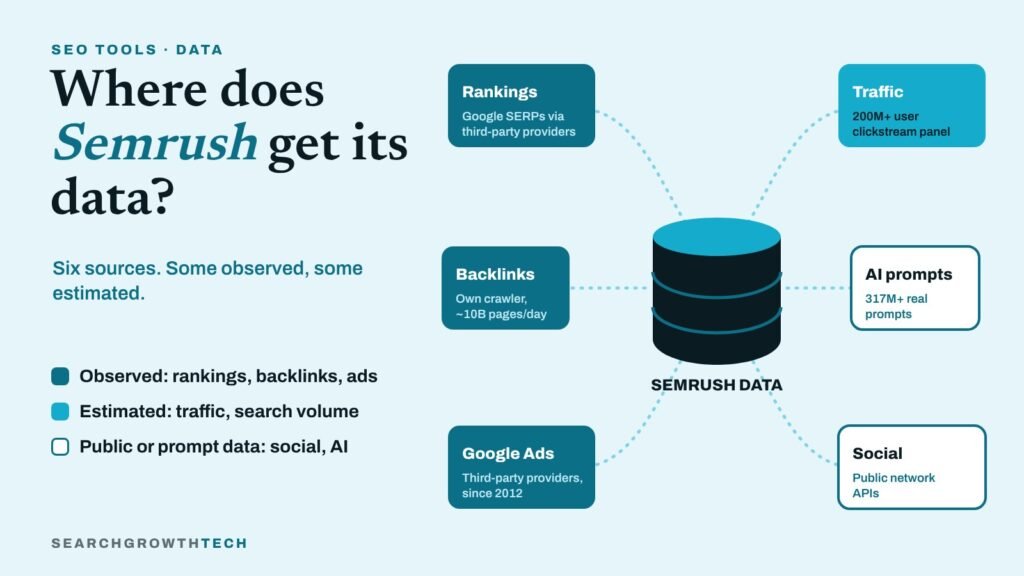
Related: where Semrush gets its data, useful when comparing third-party estimates with Search Console, and how Google Search works.
More SEO tool news in our SEO Tools section.
Sources: Google Search Central blog, Search Analytics API documentation.