Semrush can tell you roughly how much traffic a competitor gets, which keywords they rank for and who links to them, without access to their analytics. So where do those numbers come from? The answer matters, because each type of Semrush data is collected differently, and that decides how far you can trust it.
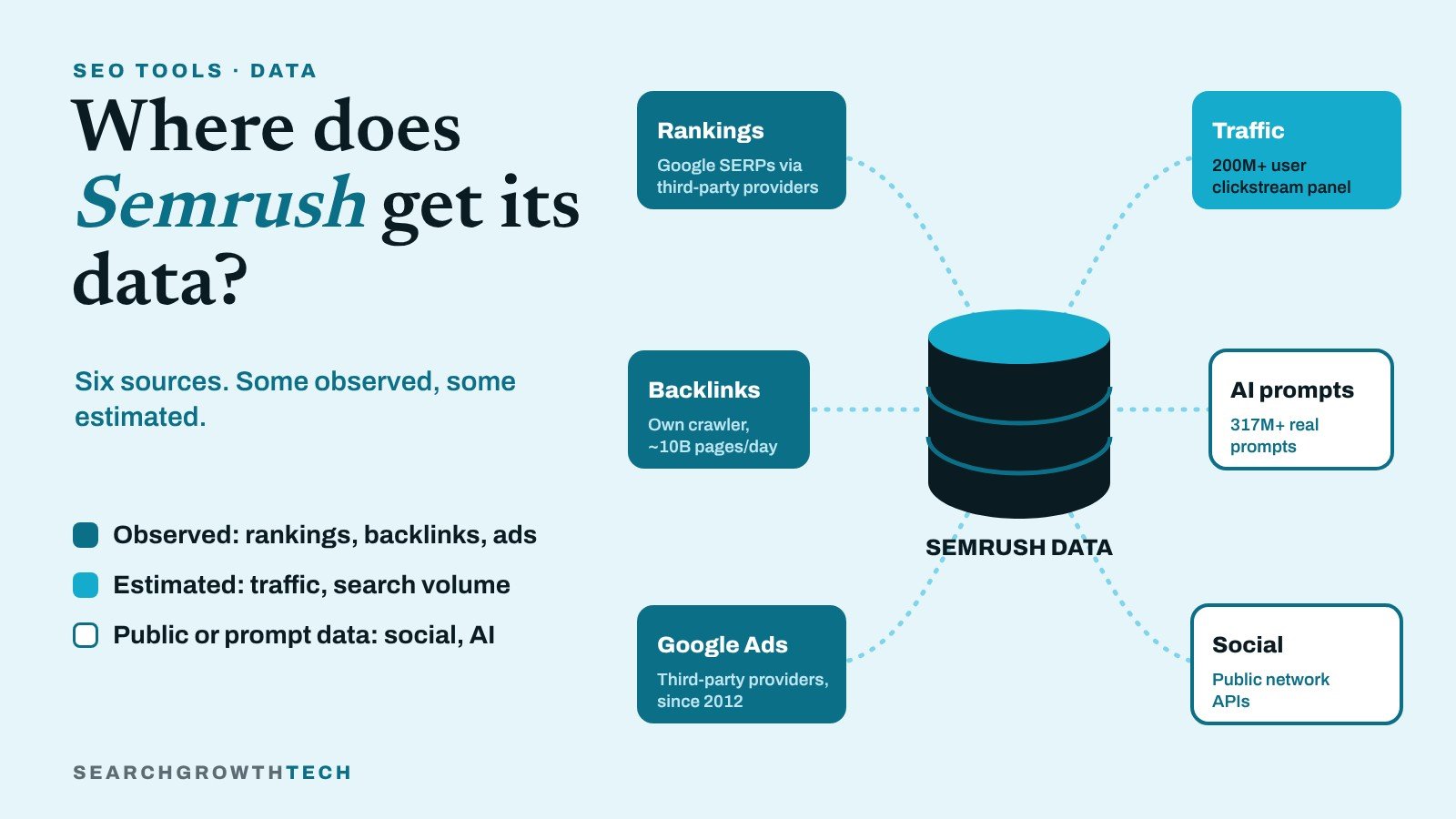
In short: Semrush gets its data from six main sources. Third-party providers collect Google results pages for its keyword and ranking data. A clickstream panel of over 200 million anonymized users powers its traffic estimates. Its own crawler builds its backlink index. Third-party providers supply its Google Ads data. Public social media APIs feed its social data. A database of over 317 million AI prompts and responses tracks AI visibility. Some of these numbers are observed directly, such as rankings and backlinks. Others are modeled estimates, such as traffic and search volume. Facts below were checked against Semrush’s knowledge base on 5 November 2026.
Semrush Data Sources at a Glance
| Data type | Where it comes from, according to Semrush | Observed or estimated? |
|---|---|---|
| Keyword rankings | Third-party providers collect Google results pages for hundreds of millions of popular keywords, tracking the top 100 positions | Observed (a snapshot at collection time) |
| Search volume, CPC | Generated from Semrush’s analysis of live and historical results data, using its own algorithm | Estimated |
| Website traffic | Clickstream panel of 200M+ anonymized users in 190+ countries and regions, processed by a neural network model | Estimated |
| Backlinks | Semrush’s own crawler, which it says crawls about 10 billion pages a day | Observed |
| Google Ads and Shopping ads | Third-party providers. History goes back to January 2012 | Observed |
| Social media | Public APIs of networks such as Facebook, Instagram, YouTube, Pinterest and LinkedIn | Observed (public data only) |
| AI visibility | 317M+ prompts and responses captured from real requests, sourced from AI search clickstream data and Google’s AI Overviews keyword dataset | Observed answers, estimated volumes |
The “observed or estimated” column is our own reading of Semrush’s descriptions. It is the most useful way to judge any number you see in the tool.
1. Keyword and Ranking Data
Semrush says it partners with third-party data providers to collect Google’s search results pages for hundreds of millions of the most popular keywords. It records which sites appear in the top 100 positions, in both organic and paid results.
- Update frequency: Semrush says keywords are refreshed anywhere from once a day to once a month, depending on how popular each keyword is. Smaller databases can take longer.
- What this means: rankings for popular keywords are close to current. Rankings for rare, long-tail keywords may be weeks old, or missing entirely.
- Derived metrics: search volume, cost per click and position changes are calculated from this data using Semrush’s own algorithm.
2. Website Traffic Data
This is the most-asked part of the question, because traffic is the one number Semrush cannot see directly.
Semrush says its Traffic & Market toolkit uses a panel of over 200 million real, anonymized internet users across more than 190 countries and regions. The panel is built from hundreds of clickstream data providers and records billions of online events each month. Semrush then runs that data through a neural network model that also uses its backlink and ranking databases to estimate traffic and visitor behavior.
In plain terms: Semrush watches what a large sample of users does online and uses it to estimate what all users do. That works better for big sites, where the sample is large, than for small or niche sites, where only a handful of panel users may visit.
3. Backlink Data
Semrush builds its backlink index with its own crawler. It says the crawler visits about 10 billion pages a day and that its database holds over 43 trillion backlinks.
Because this is crawled directly, a backlink in Semrush is a real link Semrush found. The limits are coverage and timing: no crawler sees the whole web, and links can be added or removed between crawls. Site owners can also block Semrush’s crawlers in robots.txt, which leaves gaps.
4. Advertising Data
Semrush says its Google Ads and Google Shopping data comes from trusted third-party providers, with over 1 billion Google Ads in its database and history back to January 2012. For display, video and social ads, Semrush points to a separate app, AdClarity, in its App Center.
5. Social Media Data
Semrush uses the public APIs of social networks, including Facebook, Instagram, YouTube, Pinterest and LinkedIn. It collects only public information, such as follower counts, likes, hashtags and video views, and says it never collects personal data without consent.
6. AI Visibility Data
Semrush’s AI Visibility Toolkit shows how brands appear in AI answers. According to Semrush:
- Its prompt database holds over 317 million prompts and responses from ChatGPT, Gemini, Google AI Overviews and AI Mode.
- Prompts come from AI search clickstream data and Google’s keyword dataset for AI Overviews, grouped into topics.
- Responses are captured from real requests, not through LLM APIs.
- ChatGPT data uses the latest ChatGPT model in search mode.
- Brand Performance reports (sentiment, share of voice) update weekly. Prompt Tracking updates daily for prompts you choose.
Semrush itself describes these AI metrics as “directional signals,” because AI answers change quickly and vary by user.
Semrush Database Size
As of 2026, Semrush says its database contains over:
| Metric | Size |
|---|---|
| Geographic databases | 142 |
| Keywords | 28.8 billion |
| Domains | 808 million |
| Backlinks | 43 trillion |
| Raw website traffic data | 500 TB |
| AI prompts | 317 million |
Which Search Engines and AI Platforms Does Semrush Cover?
- Most tools: Google.
- Position Tracking: Google, Bing and Baidu (top 50 results for Bing and Baidu).
- Traffic & Market: traffic estimates from Google, Bing, DuckDuckGo, Yandex and Baidu.
- AI platforms: ChatGPT, Gemini, Perplexity, SearchGPT, Google AI Mode and Google AI Overviews.
How Accurate Is Semrush Data?
It depends on the data type. A simple rule:
| Trust it for… | Be careful with… |
|---|---|
| Which keywords a site ranks for, and roughly where | Exact traffic numbers for any single site |
| Which sites link to a domain | Search volume for very niche or new keywords |
| Comparing competitors with each other | Small sites, where the clickstream sample is thin |
| Spotting trends and big changes over time | AI visibility scores as exact figures |
A 5-Minute Accuracy Check You Can Run
- Open Domain Overview in Semrush for your own site and note the estimated monthly organic traffic.
- Open Google Search Console, go to Performance, and note your clicks for the last 28 days.
- Compare the two. The gap tells you how far Semrush’s model is from reality for a site of your size and niche.
- Do the same for your top five keywords: compare Semrush positions with the average position in Search Console.
- Use that gap as a correction factor when you read Semrush estimates for competitors similar to you.
This is the most reliable way to calibrate any SEO tool, not just Semrush.
How Semrush Compares With Ahrefs
Both run their own backlink crawlers, which is why backlink counts differ between them: each crawler finds a different slice of the web. For traffic, Semrush leans on clickstream panel data plus modeling, while Ahrefs bases its organic traffic estimates on rankings and search volumes. For more on each tool, see our guides on what Semrush is and what Ahrefs is.
Key Takeaways
- Semrush’s ranking data comes from third-party providers that collect Google results for hundreds of millions of keywords.
- Traffic estimates come from a clickstream panel of 200M+ users, processed by a neural network model.
- Backlinks come from Semrush’s own crawler, which crawls about 10 billion pages a day.
- AI visibility data comes from 317M+ real prompts and responses across major AI platforms.
- Rankings and backlinks are observed. Traffic and search volume are estimates. Check them against Google Search Console.
FAQs
Where Does Semrush Get Its Data?
From third-party providers that collect Google results, a clickstream panel of over 200 million users, its own backlink crawler, third-party ad data providers, public social media APIs, and a database of 317M+ AI prompts.
Where Does Semrush Get Its Traffic Data?
From a panel of over 200 million anonymized users built from hundreds of clickstream data providers, processed through a neural network model that also uses Semrush’s backlink and ranking data.
Does Semrush Use Google Analytics Data?
Not for competitor estimates. Semrush cannot see other sites’ analytics. You can connect your own Google Analytics and Search Console to some Semrush reports.
How Accurate Is Semrush Traffic Data?
It is an estimate. It is usually more reliable for large sites than for small or niche ones. Compare it with your own Search Console data to see how close it is for sites like yours.
How Often Does Semrush Update Its Data?
Keyword data updates from daily to monthly depending on popularity. Brand Performance AI data updates weekly, and Prompt Tracking updates daily.
How Does Semrush Get Backlink Data?
With its own crawler, which Semrush says crawls about 10 billion web pages a day and has found over 43 trillion backlinks.