Google BERT is a language model that Google added to Search in October 2019 to better understand what people mean when they type a query. Instead of matching keywords one by one, BERT reads each word in the context of the words around it.
When Google announced it on October 25, 2019, it said BERT would help Search understand about one in 10 English-language searches in the US. Google called it the biggest leap forward in five years. By October 2020, Google said BERT was used on almost every English query.
BERT was not a penalty or a quality update. It changed how Google interprets searches and content, especially longer, conversational queries where small words like “to,” “for” and “no” change the meaning.
Watch: Google BERT Update Explained
What Is Google BERT?
BERT stands for Bidirectional Encoder Representations from Transformers. It is a natural language processing (NLP) model built on the transformer architecture.
“Bidirectional” is the key idea. Older approaches tended to process words in order, one after another. BERT looks at the words before and after each word at the same time, which helps it work out what that word means in that particular sentence.
Google’s research team published BERT and open-sourced it in November 2018, a year before it reached Search. Pandu Nayak, a Google Fellow and Vice President of Search, announced its use in ranking in a post titled “Understanding searches better than ever before.”
Google BERT: Key Facts
| Item | Details |
|---|---|
| Announced | October 25, 2019 |
| Announced by | Pandu Nayak, Google Fellow and VP of Search |
| Full name | Bidirectional Encoder Representations from Transformers |
| What it did | Improved Google’s understanding of the meaning and context of queries |
| Queries affected at launch | About 1 in 10 US English searches, plus featured snippets in the roughly two dozen countries where they were available |
| Expansion | More than 70 languages by December 2019; almost every English query by October 2020 |
| Status today | Listed by Google as one of its ranking systems currently in use |
Why Google Launched BERT
People often search the way they talk, but for years many learned to type in “keyword-ese,” stringing together words they thought a search engine would understand.
That worked poorly for longer, more natural queries. Earlier systems could miss the role of short words like prepositions, or ignore a word such as “no” that reverses the meaning of a search.
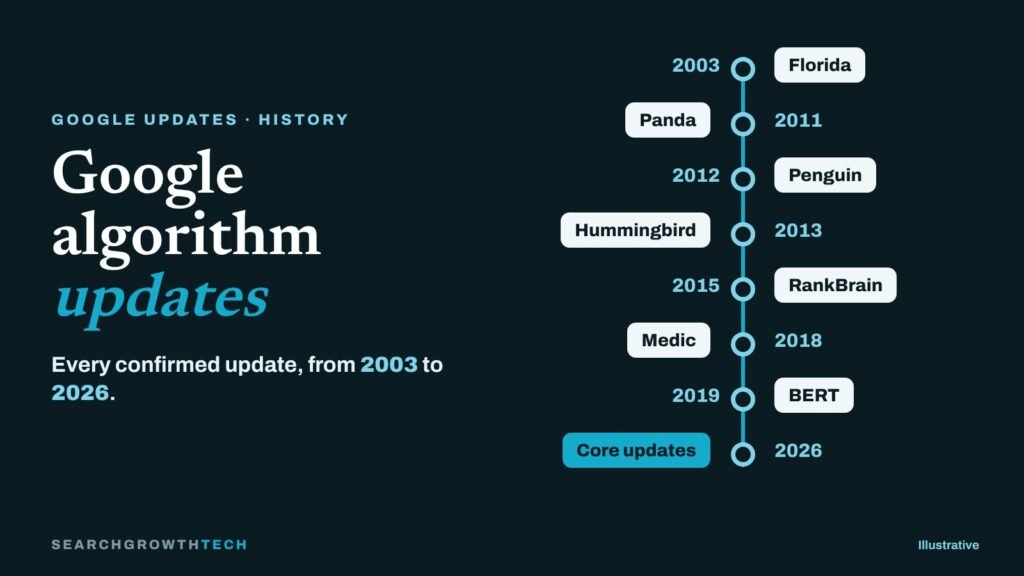
Google had already moved toward meaning-based search with Hummingbird in 2013 and RankBrain in 2015. BERT went further by modeling how every word in a query relates to every other word.
The model was also demanding to run. Google said that for the first time it was using its latest Cloud TPUs (custom AI chips) to serve search results, because some BERT models were too complex for traditional hardware.
How BERT Changed Search Results
Google shared several before-and-after examples in its announcement:
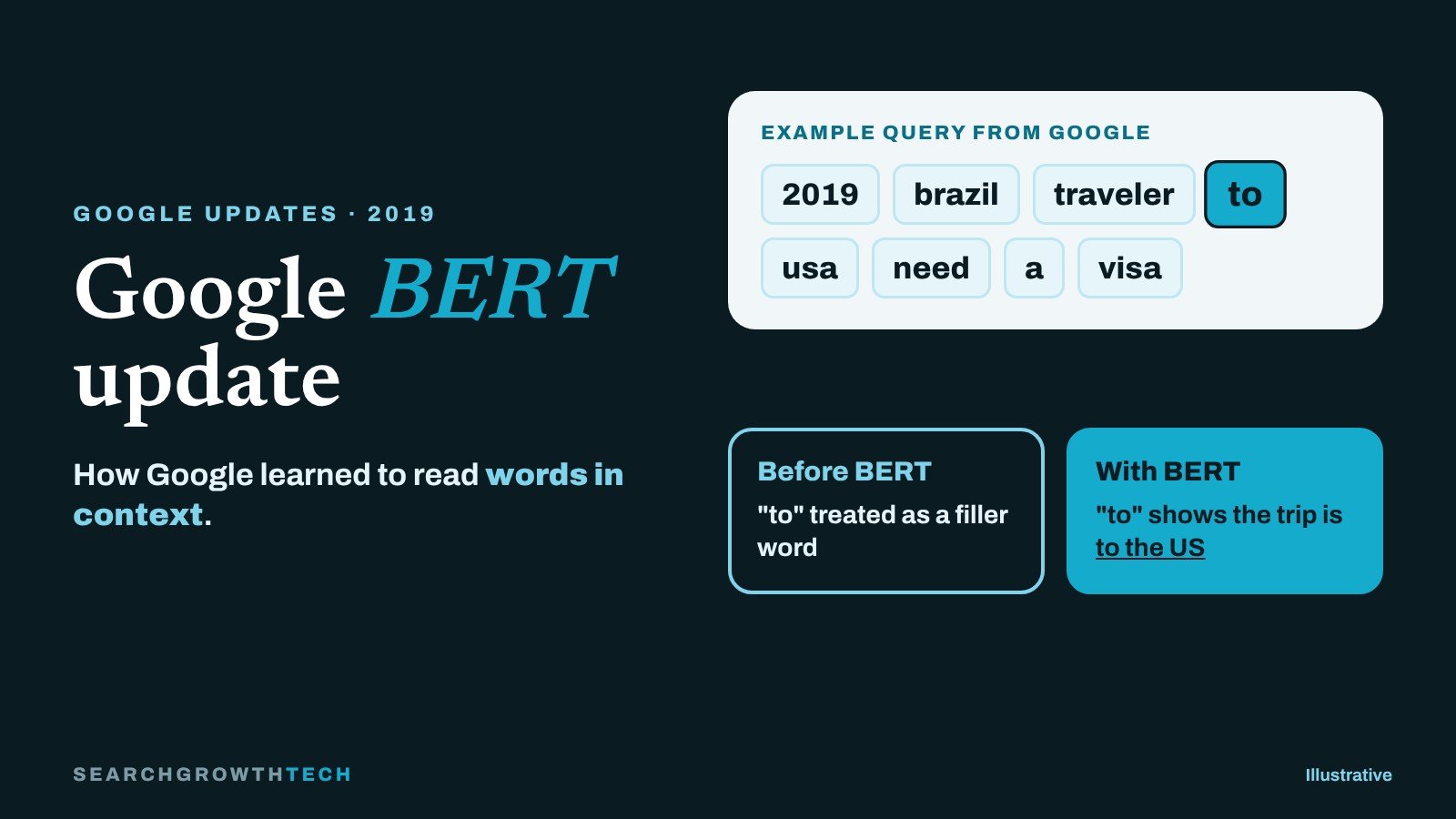
- “2019 brazil traveler to usa need a visa”: Search used to return results about US citizens traveling to Brazil. BERT understood that “to” meant a Brazilian traveling to the US.
- “do estheticians stand a lot at work”: older systems matched “stand” with “stand-alone.” BERT understood the query was about the physical demands of the job.
- “can you get medicine for someone pharmacy”: BERT recognized that “for someone” was the important part, rather than returning general results about filling prescriptions.
- “parking on a hill with no curb”: earlier systems gave too much weight to “curb” and ignored “no.” BERT took “no” into account.
BERT was used in two places at launch:
- Ranking: helping Google understand US English queries and match them with relevant pages.
- Featured snippets: improving snippet selection in all countries where featured snippets were offered, with notable gains in Korean, Hindi and Portuguese.
Google was open about the limits. It noted that BERT still made mistakes, giving the example of a query about which state is south of Nebraska, where it guessed at a community called South Nebraska.
Timeline Of BERT In Search
| Date | What happened |
|---|---|
| November 2018 | Google Research open-sources BERT. |
| October 25, 2019 | Google announces BERT in Search for about 1 in 10 US English queries and for featured snippets. |
| December 9, 2019 | Google Search Liaison announces BERT has expanded to more than 70 languages. |
| October 2020 | At its Search On event, Google says BERT is used on almost every English query. |
| November 2022 | Google lists BERT in its public guide to ranking systems currently in use. |
Who Was Affected?
BERT did not target any type of site or tactic. It changed how Google understood queries, so the effects were spread thin across many searches rather than concentrated in one industry.
Google did not report winners or losers. Based on how BERT works, the queries most likely to change were longer, more specific ones, where a better reading of the query could bring up a different result. Pages that matched keywords without really answering the question had the most to lose.
What BERT Means For SEO Today
Shortly after launch, Danny Sullivan said there was nothing to optimize for with BERT. Google’s long-standing advice to write content for users did not change.
That remains true. BERT rewards pages that clearly answer what people actually mean, so the practical lessons are about clarity:
- Write naturally. Explain topics the way an expert would to a reader, not the way a keyword list reads.
- Answer the specific question. Cover the details that change the meaning, such as who, where, for whom and under what conditions.
- Stop keyword stuffing. Repeating exact phrases does little when Google understands meaning and context.
- Use clear structure. Descriptive headings and direct answers help both readers and featured snippets.
Google has since added other language systems, such as MUM, though Google says MUM is used for specific applications rather than general ranking. For more context on how Google’s understanding of language has evolved, see our complete list of Google algorithm updates.
Key Takeaways
- BERT is a language model Google added to Search on October 25, 2019.
- At launch it affected about 1 in 10 US English searches; by October 2020 it was used on almost every English query.
- BERT reads words in context, which helps with prepositions, negations and conversational queries.
- Google said there is nothing specific to optimize for. Clear, helpful writing is the best approach.
- BERT is still listed by Google as one of its active ranking systems.
FAQs
Is BERT An Algorithm Update?
BERT is better described as a language understanding system that Google added to its ranking and featured snippet systems. It was not a penalty or a core update.
Can You Optimize For Google BERT?
Not directly. Google said there is nothing to optimize for. The best approach is writing clear content that fully answers what searchers mean.
What Is The Difference Between BERT And RankBrain?
Both help Google understand language. Google describes RankBrain as helping it relate words to concepts, while BERT helps it understand how combinations of words express different meanings and intent. Google uses both.
Does BERT Work In Languages Other Than English?
Yes. Google expanded BERT to more than 70 languages in December 2019.